Skip to content
Monday 10 August 2026London --:--Frankfurt --:--Zurich --:--
NewslettersSearchEN · DE
MorningWire

European business, markets and politics

FTSE 100
10,867.15
-0.31%
DAX
26,402.30
+0.31%
CAC 40
8,716.49
+0.02%
STOXX 50
6,548.83
+0.38%
  • Europe
  • Markets
  • Business
  • Economy
  • Technology
  • Politics
  • Opinion
More
GermanyFranceBankingAIEnergyFintechPropertyCapital Markets
  • Germany
  • France
  • Europe
  • Markets
  • Business
  • Economy
  • Technology
  • Politics
  • Opinion
  • DE
Tuesday 08 October 2024 6:00 am  |  Updated:  Thursday 24 October 2024 11:21 am

Bank of England should not adopt ‘aggressive’ rate cuts

By: Chris Dorrell

Add as a preferred source on Google
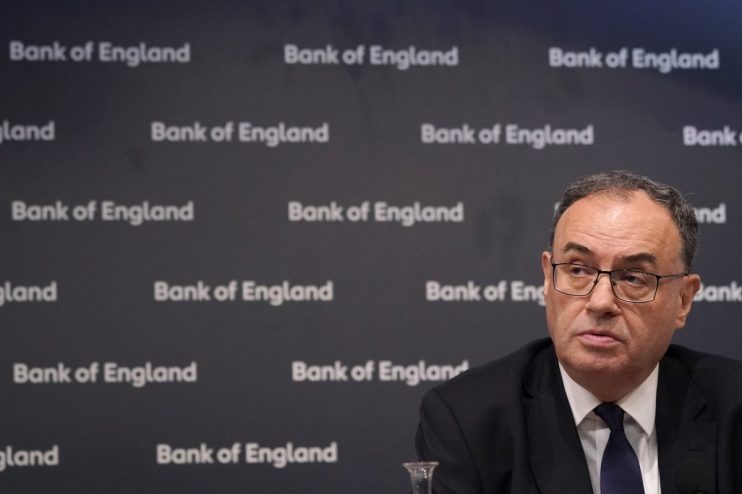
Andrew Bailey, Governor of the Bank of England, has spoken about his job market worries ahead of the next interest rates decision. Photo credit should read: Alberto Pezzali/PA Wire
Andrew Bailey signed a statement supporting the Federal Reserve's Jay Powell

Markets got excited last week about a perceived change in direction from the Bank of England.

In an interview with the Guardian, Governor Andrew Bailey said there was a chance that the Bank could become a “bit more activist” on rate cuts in the months ahead.

This was something of a surprise given his cautious outlook throughout September, when he suggested rates would only be cut “gradually”. It was doubly surprising, considering there had been no major pieces of economic data to prompt a change in heart.

The pound slumped in response as markets moved to price in a more rapid reduction in interest rates, with traders now more or less expecting two further cuts in 2024.

However, there’s a strong case that markets over-interpreted the comments, which – as ever – contained a crucial caveat.

Bailey did not climb onto the roof of the Bank of England and shout “aggressive”. He said faster rate cuts might come if there was further progress on inflation.

Play Video

As analysts at Goldman Sachs wrote, “Without further context, we would be wary of interpreting the interview comments as a shift in thinking from the Bank.”

Huw Pill, the Bank’s chief economist, was much less gung-ho when he spoke on Friday, declaring there was still “ample reason for caution” on interest rates.

Bailey and Pill indeed have different views on inflation. After all, Bailey voted for August’s rate cut when Pill did not.

However, Pill’s view more clearly represents the view of the economy, which the Bank of England laid out in its most recent Monetary Policy Report. Two surveys published last Thursday reinforced this perspective.

First, the Bank’s decision-maker panel, which surveys business leaders across the country, suggested progress on inflation might be slowing.

The survey showed firms’ realised price growth over the past year rose to 4.5 per cent in September, higher than last month’s figure of 3.9 per cent and the highest figure since May.

Read more

Interest rate cut is ‘off the table’, says Bank of England governor

Governor Andrew Bailey has launched a defence of the Federal Reserve's independence.

Wage growth also proved more stubborn than economists had anticipated.

Expected wage growth remained stuck at 4.1 per cent, more or less unchanged since May, while realised wage growth stayed at 5.7 per cent for the third consecutive month.

The nuance was slightly different in S&P’s purchasing managers’ index (PMI) for the services sector, but the risk was the same.

The PMI suggested services inflation fell to its lowest level since February 2021, which is undoubtedly good news given the emphasis that policymakers have put on services inflation.

But firms also reported a “sharp and accelerated” increase in costs, largely due to stronger pay growth. The survey suggested that firms were unable to pass on higher costs to consumers, but it did not show meaningful progress on the cost pressures themselves.

This points to the delicate balance which rate-setters have to navigate.

Firms are still facing stubborn cost pressures. There’s no doubt about that. At the moment this is not translating into significantly higher inflation because demand remains weak.

If demand recovers quickly – sparked, for instance, by an “aggressive” rate cutting cycle – then firms may be in a position to pass on higher costs to consumers.

This is the scenario laid out by Megan Greene, an external member of the MPC, in a recent speech.

“As interest rates fall, the drag on activity from monetary policy wanes, the labour market strengthens, and consumers are likely to feel less worried about their future income. This should result in a lower savings rate and a rebound in consumption,” she said.

That’s not to say that rates couldn’t be reduced, but a gradual approach seems sensible both to quash the lingering inflationary pressures and to ensure that consumption does not rapidly rebound.

Anything more aggressive would risk upsetting the delicate disinflationary balance which seems to be at work.

Read more

Bank of England governor opens door to ‘simplifying’ financial rulebook

Bank of England Governor Andrew Bailey said cited several indicators that the labour market was softening.

Share this article

  • Facebook
  • X
  • LinkedIn
  • WhatsApp
  • Email

Similarly tagged content:

Sections

  • News

Categories

  • Economics

People & Organisations

  • Andrew Bailey
  • Bank of England
  • BoE
  • interest rates
  • UK economy
  • UK Government
  • UK inflation
  • UK Interest Rates

Related Topics

  • Bank of England
  • UK inflation
  • UK interest rates

Trending Articles

  • Back to basics: Sainsbury’s gradual retreat from the British high street

  • Thames Water faces fresh threat to survival after pensions regulation breach

  • Hargreaves Lansdown orders staff back to office

  • FTSE 100 Live: Stocks drop as US-Iran peace stalls; Oil climbs higher

  • PwC’s Embankment HQ to get major makeover ahead of Canary Wharf move

More from Morning Wire

  • Interest rate cut is ‘off the table’, says Bank of England governor

    Economics
    Governor Andrew Bailey has launched a defence of the Federal Reserve's independence.
  • Bank of England governor opens door to ‘simplifying’ financial rulebook

    Regulation
    Bank of England Governor Andrew Bailey said cited several indicators that the labour market was softening.
  • Bank of England warns Burnham of UK economy’s ‘big issue’

    Economics
    Bank of England Governor Andrew Bailey said the future of interest rates was "more uncertain".
  • Bank of England may set the stage for interest rate hikes this year

    Economics
    Bank of England recession warning
  • Bank of England holds interest rates but warns of rises to come

    Economics
    Bank of England headquarters in 2025, showcasing modern architecture and iconic London skyline in the background.
  • Natwest boss becomes latest City figure caught in AI social media scam

    Banking
    NatWest building exterior with logo, highlighting corporate presence and architecture on a business news website.
  • How patient can the Bank of England be?

    AD
    Historic Royal Exchange building in London with modern skyscrapers behind, clear blue sky.
  • Bank of England to relax capital rules despite warning of economic threats

    Banking
    Bank of England building on Threadneedle Street, London, showcasing its historic architecture and financial significance
MorningWire

Independent European business, markets and political news for decision-makers.

Morning Briefing

Europe

  • Germany
  • France
  • Europe
  • UK & Ireland

Business

  • Markets
  • Banking
  • Technology
  • Energy
  • Property
  • Fintech

Editorial

  • Opinion
  • Editorial Policy
  • Corrections
  • Contact

Company

  • About Morning Wire
  • Privacy Policy
  • Terms of Use
  • Cookie Policy
© 2026 Morning Wire Ltd · Published by Morning Wire Media, Bahnhofstrasse 65, 8001 Zürich, Switzerland
Privacy · Terms · Cookies · Facebook