Skip to content
Friday 4 September 2026London --:--Frankfurt --:--Zurich --:--
NewslettersSearchEN · DE · FR
MorningWire

European business, markets and politics

FTSE 100
10,820.26
-0.10%
DAX
26,142.62
+0.54%
CAC 40
8,279.83
-0.08%
STOXX 50
6,402.66
+0.31%
  • Europe
  • Markets
  • Business
  • Economy
  • Regulation
  • Politics
  • Opinion
More
GermanyFranceEU InstitutionsCompetitionPublic AffairsBankingTechnologyEnergy
  • Germany
  • France
  • Europe
  • Markets
  • Business
  • Economy
  • Regulation
  • Politics
  • Opinion
  • DE
Wednesday 18 May 2022 11:21 am  |  Updated:  Wednesday 18 May 2022 4:47 pm

Bank of England to launch brisk rate hike cycle to tame 40-year high inflation
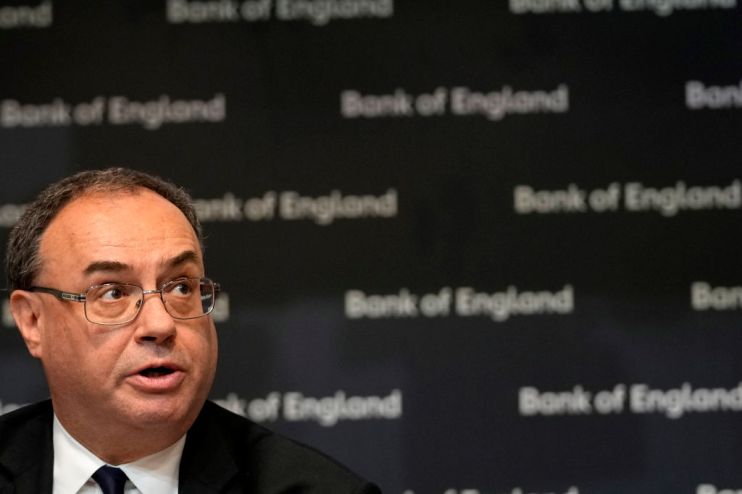
Bank of England Holds Interest Decision Rate News Conference
The case for front-loading rate rises is strengthening after new figures published this morning by the Office for National Statistics (ONS) revealed inflation climbed to nine per cent last month, the steepest rate since 1982 (Photo by Frank Augstein - WPA Pool/Getty Images)

The Bank of England will have to launch a cycle of steeper and quicker rate hikes to tame the steepest rise in living costs in four decades, according to City economists.

The case for front-loading rate rises is strengthening after new figures published this morning by the Office for National Statistics (ONS) revealed inflation climbed to nine per cent last month, the steepest rate since 1982 and around four and a half times the Bank’s two per cent target.

Historically high price rises up “the ante even further for the Bank of England to respond,” Sandra Horsfield, an economist at fund manager Investec, warned, adding taking the extremely tight UK jobs market into account, “the case for frontloading monetary tightening looks stronger by the day”.

Bank of America analysts are pencilling in “four more consecutive 25 basis point rate hikes by the BoE with a high risk rate setters choose to hike 50 basis points in August”.

The cost of living crunch is unlikely to ease over the course of the year, resulting in the sharpest fall in spending power since the 1950s.

Households are expected to cut spending in response to their living standards falling, likely tipping the UK into a recession, economists are predicting.

Soaring international energy prices caused by a resurgence in demand after the Covid-19 unlocking and Russia’s invasion of Ukraine have propelled inflation in the UK.

Gas and electricity prices accounted for around a fifth of overall inflation in the UK last month due to the 54 per cent upgrade to the energy price cap taking effect in April, according to calculations by Samuel Tombs, chief UK economist at Pantheon Macroeconomics.

Inflation jumped two percentage points in April, from seven per cent, the steepest rise since 1980 and underscoring the severity of the energy price crunch.

“Today’s inflation numbers are driven by the energy price cap rise in April, which in turn is driven by higher global energy prices,” chancellor Rishi Sunak said.

Read more

Mortgage nightmare as investors price in three interest rate hikes 

Bank of England building on Threadneedle Street, London, showcasing its historic architecture and financial significance

The Treasury is reportedly mulling bringing forward a planned 2024 income tax cut and launching another package of support in July to tackle the cost of living crunch.

“Of course, as the situation evolves our response will evolve. I have always been clear, we stand ready to do more,” Sunak will say in a speech at the Confederation of British Industry’s annual dinner later today.

Bank governor Andrew Bailey said earlier this week rate setters would be unable to prevent inflation topping 10 per cent later this year due to around 80 per cent of the present rise in living costs being driven by higher energy prices.

However, former Bank chief Mervyn King criticised that assessment, telling LBC yesterday that leaving rates at one per cent while inflation is running at historically high levels is “really very strange”.

He supported a steeper and quicker series of policy adjustments and said the Bank had pumped too much money into the economy through bond buying during the pandemic.

Today’s ONS print also indicated domestic inflationary pressures are to blame for swelling living costs.

Core inflation jumped to a 30-year high of 6.2 per cent, driven by services firms lifting prices to offset wage pressures and the VAT rate returning to 20 per cent.

“Some of these moves are due to global factors, but there are clearly domestic drivers too,” Paul Dales, chief UK economist at Capital Economics, said.

Monetary policy is more effective at cooling inflation that is driven by home-grown pressures. Higher rates drive down domestic consumption by making it more attractive to save and more expensive to borrow.

Dales added that the Bank will send borrowing costs to a peak of three per cent.

Read more

How patient can the Bank of England be?

Historic Royal Exchange building in London with modern skyscrapers behind, clear blue sky.

Share this article

  • Facebook
  • X
  • LinkedIn
  • WhatsApp
  • Email

Similarly tagged content:

Sections

  • Markets & Economics
  • News

Categories

  • Economics

Trending Articles

  • Victoria Beckham owed £350,000 by Harvey Nichols

  • Jim O’Neill: Capital gains tax hike ‘looms’ as top option for Burnham

  • Vodafone and Deliveroo look to patch up Reform ties after Yusuf prison threats

  • M&G: FTSE 100 giant hits out at Rayner’s ground rent cap as it suffers loss

  • ‘Large tax hikes on the way’: How the global bond rout is boxing in Healey

More from Morning Wire

  • Mortgage nightmare as investors price in three interest rate hikes 

    Economics
    Bank of England building on Threadneedle Street, London, showcasing its historic architecture and financial significance
  • How patient can the Bank of England be?

    AD
    Historic Royal Exchange building in London with modern skyscrapers behind, clear blue sky.
  • Inflation expectations softer than predicted ahead of interest rate decision

    Economics
    The Bank of England is expected to hold interest rates at four per cent due to stubbornly high inflation.
  • Bank of England’s Pill warns against ‘wait and see’ interest rates approach

    Economics
    Huw Pill, Bank of England Chief Economist, smiling in a suit and tie against a blue NABE banner.
  • Shop price inflation hits two-year high as rising energy costs hit consumers

    Economics
    Retail sales slumped in May as tax hikes and economic uncertainty hit shoppers' spending
  • El Nino heatwaves to ‘fuel inflation next year’

    Economics
    Firefighter in helmet and uniform watching a blazing forest fire at night, red glow in the sky
  • Inflation leaps to 2.9 per cent in blow to Burnham 

    Economics
    Burnham cityscape showcasing modern architecture, bustling streets, and vibrant community life in a thriving urban setting
  • As it happened: Vodafone leads FTSE 100 rally after TV launch; oil jumps again

    FTSE 100 Live
    Vodafone and Three company logos on a red and white sign outside a modern glass building
MorningWire

Independent European business, markets and political news for decision-makers.

Morning Briefing

Europe

  • Germany
  • France
  • EU Institutions
  • Europe

Business

  • Markets
  • Business
  • Economy
  • Regulation
  • Competition
  • Public Affairs

Editorial

  • Opinion
  • Editorial Policy
  • Corrections
  • Contact

Company

  • About Morning Wire
  • Privacy Policy
  • Terms of Use
  • Cookie Policy
© 2026 Morning Wire Ltd · Published by Morning Wire Media, Bahnhofstrasse 65, 8001 Zürich, Switzerland
Privacy · Terms · Cookies · Facebook