Skip to content
Wednesday 2 September 2026London --:--Frankfurt --:--Zurich --:--
NewslettersSearchEN · DE · FR
MorningWire

European business, markets and politics

FTSE 100
10,756.45
-0.30%
DAX
25,839.33
-0.50%
CAC 40
8,280.63
-0.26%
STOXX 50
6,362.15
-0.11%
  • Europe
  • Markets
  • Business
  • Economy
  • Regulation
  • Politics
  • Opinion
More
GermanyFranceEU InstitutionsCompetitionPublic AffairsBankingTechnologyEnergy
  • Germany
  • France
  • Europe
  • Markets
  • Business
  • Economy
  • Regulation
  • Politics
  • Opinion
  • DE
Wednesday 20 May 2020 4:53 pm  |  Updated:  Wednesday 20 May 2020 4:59 pm

BoE’s Andrew Bailey: It would be ‘foolish’ to rule out negative interest rates

By: Harry Robertson

Add as a preferred source on Google
BoE's Andrew Bailey: It would be 'foolish' to rule out negative interest rates
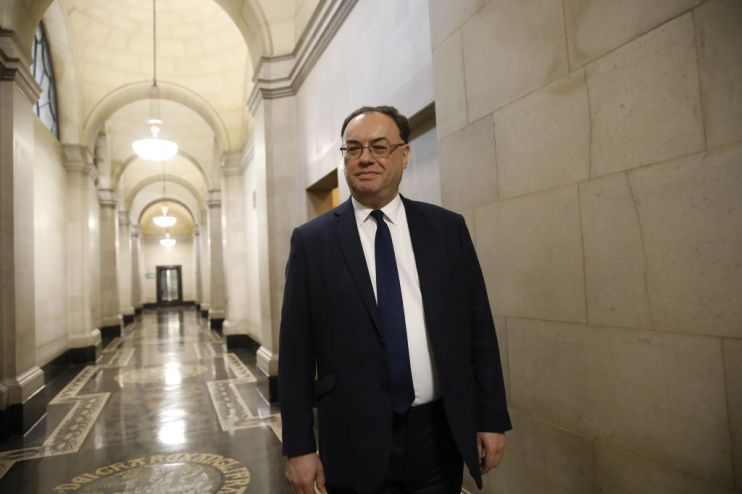
Bank of England governor Andrew Bailey has previously expressed opposition to negative interest rates

Bank of England governor Andrew Bailey has said it would be “foolish” to rule out negative interest rates but said the BoE is “not ruling it in” either.

The governor has previously argued against negative rates but admitted today: “I have changed my position a bit.”

Chatter about negative interest rates has increased in recent days. Traders’ bets in the markets have indicated that they could be put in place by December. Meanwhile, some BoE policymakers have said they should be considered.

The Bank has taken unprecedented actions to tackle coronavirus’s effects on the economy. These include slashing interest rates to a record low of 0.1 per cent and ramping up its bond-buying programme.

Sticking broadly to the line he has followed in recent weeks on negative rates, Bailey told MPs on Parliament’s Treasury Committee (TC): “We do not rule things out as a matter of principle, that would be, I think, a foolish thing to do.”

He was keen to highlight that the Bank is not saying it will cut rates further: “We’re not ruling it in but we’re not ruling it out.”

Negative interest rates mean banks have to pay to keep money in their central bank’s virtual vaults. They are designed to spur lending but limit banks’ profitability.

Bailey admits slight shift on negative rates

Although he has previously said he does not think negative interest rates are appropriate for the UK, Bailey was more circumspect today. 

He admitted as much, saying: “I have changed my position a bit. And that is because… in this situation we have to review our tools as a matter of regularity.”

His appearance before the TC alongside other Bank colleagues came after data showed that UK inflation slumped to 0.8 per cent in April. That is well below the Bank of England’s two per cent target.

Read more

Andrew Bailey warns markets are not ready for the rise (or fall) of AI

Andrew Bailey, Governor of the Bank of England, in a suit and tie, looking thoughtful during a press conference.

The BoE thinks the UK economy could shrink by 14 per cent this year. That would be the worst contraction in 300 years.

Listen to our daily City View podcast as we chart the economic fallout and business impact of the coronavirus pandemic.

The governor said the Bank is studying the effects of negative rates in countries that use them. The Eurozone and Japan are examples. Bailey said there “are some pretty mixed reviews” of the policy.

“There are a lot of issues around for instance how it would affect the structure of the financial system,” he said.

Bank’s optimism questioned

Probed by MPs about the Bank’s expectations for the economy, deputy governor Ben Broadbent played down the idea that Threadneedle Street was predicted a rapid rebound.

“If one is to use a letter of the alphabet – and I hear a lot about our scenario being V-shaped – it is a pretty lopsided V,” he said. 

“There is no doubt that in our scenario the recovery is far from immediate and takes place over a longer period of time.”

The Bank foresees 15 per cent growth in 2021 with the economy returning to its pre-Covid size in the second half of that year. That is more optimistic than most other predictions.

Bailey said he is “not very much taken with using letters to describe” the shape of the recovery. But he said the Bank believes government support schemes are working well in limiting the economic damage.

Read more

How the Treasury got ‘fed up’ with the Bank of England’s payments plan

The Bank of England's Breeden argued the recent inflation bump was transitory (Photo by Chris Ratcliffe/Bloomberg via Getty Images)

Share this article

  • Facebook
  • X
  • LinkedIn
  • WhatsApp
  • Email

Similarly tagged content:

Sections

  • Markets & Economics
  • News

Categories

  • Banking
  • Business
  • Economics

Trending Articles

  • Vodafone and Deliveroo look to patch up Reform ties after Yusuf prison threats

  • Trio of firms poised to quit London Stock Exchange as exodus gathers pace

  • Jaguar reveals the Type 01’s screen-free interior

  • Easyjet’s over-60s recruitment push is economically necessary

  • Jim O’Neill: Capital gains tax hike ‘looms’ as top option for Burnham

More from Morning Wire

  • Andrew Bailey warns markets are not ready for the rise (or fall) of AI

    Markets
    Andrew Bailey, Governor of the Bank of England, in a suit and tie, looking thoughtful during a press conference.
  • How the Treasury got ‘fed up’ with the Bank of England’s payments plan

    Fintech
    The Bank of England's Breeden argued the recent inflation bump was transitory (Photo by Chris Ratcliffe/Bloomberg via Getty Images)
  • Reform’s Richard Tice under parliamentary investigation

    Politics
    Reform UK leader Nigel Farage and Deputy Leader Richard Tice are set to meet with Andrew Bailey to discuss interest rates and stablecoins.
  • Fed chair Kevin Warsh faces Jackson Hole D-Day

    Economics
    Kevin Warsh, former Fed Governor, in a suit and blue tie, attending Jackson Hole meeting.
  • Economists urge Bank of England to halt bond sales as borrowing costs climb

    Economics
    Bank of England headquarters with financial charts overlay, illustrating private credit stress test analysis
  • How patient can the Bank of England be?

    AD
    Historic Royal Exchange building in London with modern skyscrapers behind, clear blue sky.
  • Mortgage nightmare as investors price in three interest rate hikes 

    Economics
    Bank of England building on Threadneedle Street, London, showcasing its historic architecture and financial significance
  • The decline of Harvey Nichols is a tale of London’s decline too

    Opinion
    Harvey Nichols department store at night, illuminated with neon signs and colorful window displays.
MorningWire

Independent European business, markets and political news for decision-makers.

Morning Briefing

Europe

  • Germany
  • France
  • EU Institutions
  • Europe

Business

  • Markets
  • Business
  • Economy
  • Regulation
  • Competition
  • Public Affairs

Editorial

  • Opinion
  • Editorial Policy
  • Corrections
  • Contact

Company

  • About Morning Wire
  • Privacy Policy
  • Terms of Use
  • Cookie Policy
© 2026 Morning Wire Ltd · Published by Morning Wire Media, Bahnhofstrasse 65, 8001 Zürich, Switzerland
Privacy · Terms · Cookies · Facebook