Covid research suggests Coronavirus antibody levels fall rapidly in older people

While most adults in the UK are likely to have Covid-19 antibodies, levels are dropping rapidly among older age groups, new figures suggest.
The presence of coronavirus antibodies suggests someone has had the infection in the past or has been vaccinated.
It takes between two and three weeks after infection or vaccination for the body to make enough antibodies to fight the virus.
They then remain in the blood at low levels, although these can decline over time to the point that tests can no longer detect them.
The latest figures from the Office for National Statistics (ONS) are based on a sample of blood test results for the week beginning July 26.
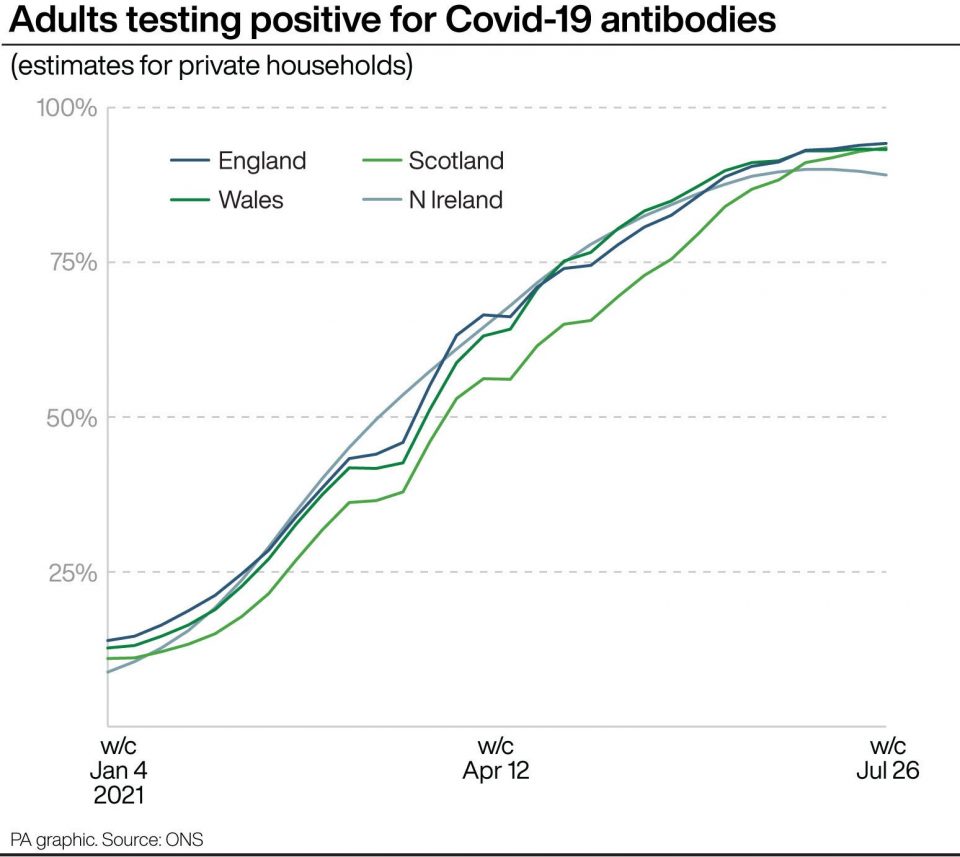
The estimates are for people in private households and do not include settings such as hospitals and care homes.
They show that in England an estimated 94.2% of adults are likely to have Covid-19 antibodies, up from 91.2% a month ago.
But while the percentages are increasing among younger adults, there are “signs of a decrease among older age groups”, the ONS said.
An estimated 92.8% of 75 to 79-year-olds in England had Covid-19 antibodies in the latest week, down from 94.4% a month earlier.
For people aged 70 to 75, the figure has dropped from 94.9% to 92.9% over the same period. For those aged 80 and over it has fallen from 92.9% to 92.4%.
Across the UK
A similar trend is evident in the other UK nations.
In Wales, estimates of antibody levels in people aged 80 and over have slipped from 90.3% to 86.6% in the most recent month, from 94.4% to 91.5% for those aged 75 to 79 and from 96.1% to 93.6% among 70 to 74-year-olds.
The latest estimate for all adults in Wales is 93.2%, up month-on-month from 91.4%.
“In some regions and countries, we are starting to see a decline in the percentage of people testing positive for antibodies amongst the oldest age groups, although rates amongst these age groups remain high,” the ONS said.
“Our analysis defines antibody positivity by a fixed amount of antibodies in the blood. Most older people who are vaccinated will retain higher antibody levels than prior to vaccination, but may have a lower number of antibodies in the blood at the time of testing.”
In Northern Ireland, the ONS uses different age groups due to small sample sizes, and estimates that 86.7% of people aged 70 and over were likely to have tested positive for antibodies in the week beginning July 26, down from 93.2% one month earlier.
The estimate for the total adult population in Northern Ireland has also fallen, down from 89.6% to 89.1% in the same period.
Scotland
For Scotland the overall estimate has risen month-on-month from 88.3% to 93.5%, but older age groups have again seen a fall, with 75-79 year-olds down from 91.6 to 90.9% and over-80s down very slightly from 87.7% to 87.6%.
The figures come as the Joint Committee on Vaccination and Immunisation (JCVI) met on Thursday to discuss a potential Covid-19 booster campaign for people who need a third dose of vaccine.
Professor Peter Openshaw, a member of the New and Emerging Respiratory Virus Threats Advisory Group (Nervtag) which advises the Government, said more evidence is needed of the benefits of booster jabs.
The professor of experimental medicine at Imperial College London told Times Radio: “In terms of boosters, we need more evidence really about what benefits those boosters will bring, because we can’t just look at the antibody levels and think that that equates to levels of protection.
“It still seems that you get a lot of protection from these vaccines, even if the antibody levels have drifted down to some sort of stable level.”
Having antibodies can help to prevent people getting coronavirus again, or if they do get infected, they are less likely to have severe symptoms.
But once infected or vaccinated, the length of time antibodies remain at detectable levels in the blood is not fully known.