Skip to content
Tuesday 18 August 2026London --:--Frankfurt --:--Zurich --:--
NewslettersSearchEN · DE · FR
MorningWire

European business, markets and politics

FTSE 100
10,711.13
-0.09%
DAX
26,222.28
-0.44%
CAC 40
8,532.01
-0.55%
STOXX 50
6,491.18
-0.60%
  • Europe
  • Markets
  • Business
  • Economy
  • Regulation
  • Politics
  • Opinion
More
GermanyFranceEU InstitutionsCompetitionPublic AffairsBankingTechnologyEnergy
  • Germany
  • France
  • Europe
  • Markets
  • Business
  • Economy
  • Regulation
  • Politics
  • Opinion
  • DE
Wednesday 27 November 2019 7:09 am  |  Updated:  Wednesday 27 November 2019 10:39 am

DEBATE: Is it viable to pay compensation to the 1950s-born women who lost out on their state pension?
By: Morgan Schondelmeier and Debbie de Spon

Add as a preferred source on Google
Britain's Labour Leader Corbyn Campaigns In The East Midlands
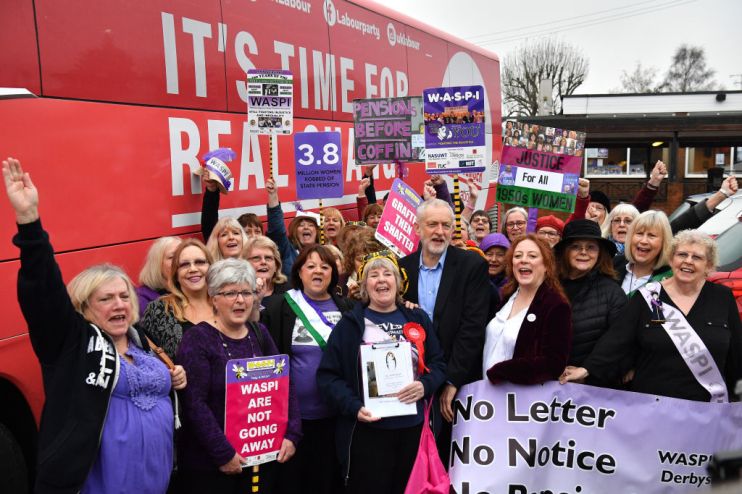
Jeremy Corbyn poses with WASPI campaigners in Renishaw

Is it viable to pay compensation to the 1950s-born women who lost out on their state pension, as Labour has proposed?

YES, says Debbie de Spon, communications director for Women Against State Pension Inequality (WASPI). 

1950s-born women are suffering severe injustice because of successive governments’ mismanagement of changes to the state pension age. This issue goes beyond the question of viability; it is one of fairness and trust.

Increases in the state pension age have had a devastating impact on many of these women. They are now seeking work in an employment market that is not ready to accept them, forced to take jobs that are inappropriate for their health, reliant on dwindling savings, or dependant on husbands, partners, or the state to support them if they are unable to work.

These women are a significant part of the electorate and have the potential to make a key contribution to the economy. However, this is not just about the money. This is about the fundamental trust between the government and ordinary people. 

The lack of communication from successive governments to the women affected broke trust that had existed for generations. Women impacted by these changes are suffering now, and a solution must be imminent.

NO, says Morgan Schondelmeier, the Adam Smith Institute’s head of development.

There is no doubt that the 1995 pension reforms had a disproportionate impact on one specific cohort, as millions of women born in the 1950s saw their retirement plans upended. However, one can be sympathetic to their plight while remembering that critical reform will always have some casualties. 

Pensions reform is a crucial step towards addressing rising welfare spending. As it stands, pensions amount to almost half of welfare spending in the UK, with old-age pensions accounting for £111bn a year. This will only increase as the UK population ages, perpetuating intergenerational inequality. 

Supporting elderly citizens is an integral part of a compassionate society, but we need to be honest about the costs and sustainability of the system. 

It is possible that more reform will be needed, and additional cohorts may face similar issues as the 1950s women. 

But it isn’t viable to transfer billions of taxpayer pounds to one cohort and risk destabilising the system as a whole.

Main image credit: Getty

Read more

Pension pressure to help swell UK debt to three times size of economy

Two older women exercising at an outdoor gym in sunshine

Share this article

  • Facebook
  • X
  • LinkedIn
  • WhatsApp
  • Email

Similarly tagged content:

Sections

  • News
  • Opinion

Categories

  • Business
  • Opinion
  • Politics

Related Topics

  • Pensions

Trending Articles

  • As it happened: FTSE 100 drops as oil prices rise after Trump makes Hormuz threat

  • US bond market jitters spark UK economy recession warning

  • Aldi boss wades into supermarket ‘price-gouging’ row

  • Monzo chair makes early exit after boardroom rift

  • New Premier League rules could see £11bn invested into new stadiums

More from Morning Wire

  • Pension pressure to help swell UK debt to three times size of economy

    Economics
    Two older women exercising at an outdoor gym in sunshine
  • The pensions triple lock is a travesty. Our politicians must fess up

    Opinion
    Young people face the risk of failing to save enough in their pension
  • Jenrick: Welfare cuts worth £50bn allows us to ‘sustainably pay’ triple lock pension

    Politics
    Robert Jenrick speaking at a podium with BRITAIN NEEDS REFORM sign, delivering a speech.
  • State-backed pension scheme plans to pump £1bn into start-ups

    Investing
    City economists have warned that the triple lock pension is unsustainable and unaffordable given the state of the UK's public finances.
  • Pensioners hit with £8bn tax bill after government freezes allowances

    Personal Finance
    City economists have warned that the triple lock pension is unsustainable and unaffordable given the state of the UK's public finances.
  • OECD sounds alarm on pension triple lock in challenge to Burnham

    Economics
    Andy Burnham discussing AI advancements at a business conference podium with delegates in the background
  • Rupert Lowe axes pensions triple lock and pledges tax cuts in economic plan

    Politics
    Rupert Lowe, former Southampton FC chairman, smiles while holding files on a city street, wearing a suit and pink tie
  • London Stock Exchange boss: We should know which companies our pensions are backing

    Markets
    Julia Hoggett and Rachel Reeves with other women leaders at a financial event, discussing pension industry overhaul.
MorningWire

Independent European business, markets and political news for decision-makers.

Morning Briefing

Europe

  • Germany
  • France
  • EU Institutions
  • Europe

Business

  • Markets
  • Business
  • Economy
  • Regulation
  • Competition
  • Public Affairs

Editorial

  • Opinion
  • Editorial Policy
  • Corrections
  • Contact

Company

  • About Morning Wire
  • Privacy Policy
  • Terms of Use
  • Cookie Policy
© 2026 Morning Wire Ltd · Published by Morning Wire Media, Bahnhofstrasse 65, 8001 Zürich, Switzerland
Privacy · Terms · Cookies · Facebook