Skip to content
Monday 7 September 2026London --:--Frankfurt --:--Zurich --:--
NewslettersSearchEN · DE · FR
MorningWire

European business, markets and politics

FTSE 100
10,822.13
-0.08%
DAX
26,006.53
-0.15%
CAC 40
8,306.15
+0.33%
STOXX 50
6,403.99
+0.17%
  • Europe
  • Markets
  • Business
  • Economy
  • Regulation
  • Politics
  • Opinion
More
GermanyFranceEU InstitutionsCompetitionPublic AffairsBankingTechnologyEnergy
  • Germany
  • France
  • Europe
  • Markets
  • Business
  • Economy
  • Regulation
  • Politics
  • Opinion
  • DE
Thursday 05 December 2019 4:26 am  |  Updated:  Wednesday 04 December 2019 5:29 pm

Does Labour’s pledge to cut rail fares make sense from a social mobility perspective?
By: Emma Revell and Grace Blakeley

Add as a preferred source on Google
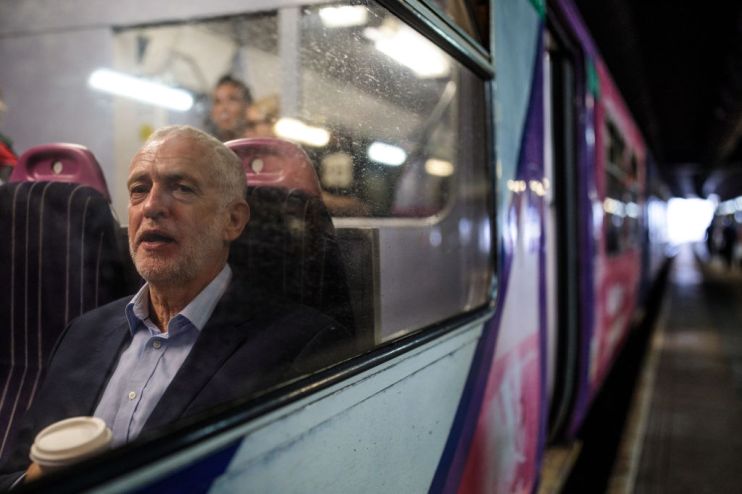
Jeremy Corbyn Travels Crossrail For The North Route
Just 11 per cent of people commute to work by train

Does Labour’s pledge to cut rail fares make sense from a social mobility perspective?

Grace Blakeley, economics columnist at the New Statesman, says YES.

Many have pointed out that middle-earners are most likely to use trains, but few analyse why.

First, trains around London are too expensive for many commuters, meaning that they are forced to use slow and cramped buses.

Second, outside London trains often aren’t an option because of the parlous state of our rail infrastructure‚ particularly when travelling from east to west in the Midlands and the North.

Understanding the impact of Labour’s pledges on transport requires taking them as a whole. As well as cutting rail fares, Labour will invest billions of pounds in infrastructure — including long-overdue projects like Crossrail for the North.

Labour will also reinstate 3,000 bus routes that have been cut under the Tories, which act as lifelines to people in rural communities.

These pledges will not only cut the cost of living for working people — they are also imperative for meeting our decarbonisation targets. Investing in public transport across the country is the only way we will achieve a just, prosperous and sustainable economy.

Read more

Virgin Trains gets green light for channel tunnel route

Red Virgin high-speed train on tracks at a station platform, under an arched glass roof, with blurred people.

Emma Revell, head of communications at the Institute of Economic Affairs, says NO.

Rail accounts for a tiny two per cent of journeys taken each year in the UK. It might not feel like it from Labour HQ in London, but just 11 per cent of people commute to work by train, and train passengers are wealthier than the average Brit.

What Labour is effectively proposing is making it cheaper for city workers to get the train from their leafy suburban home to the office, by transferring the cost of a ticket onto lower-income workers in more deprived areas of the country, who only ever drive, walk, or catch the bus to work.

Fare increases over the last two decades have in part come from a re-prioritisation of costs. In 1995, half the day-to-day cost of running the railways was borne by travellers, and the rest by taxpayers. Today, roughly 75 per cent of the cost sits on passengers’ shoulders.

It is bad public policy and bad politics to burden people who don’t use trains with the cost of the service — especially when the latter tend to be those in lower income brackets.

Main image credit: Getty

Read more

The Burnham bounce won’t last unless Brits get better off

Andy Burnham smiling and holding a pint of beer and a smartphone in a pub setting

Share this article

  • Facebook
  • X
  • LinkedIn
  • WhatsApp
  • Email

Similarly tagged content:

Sections

  • News
  • Opinion

Categories

  • Opinion
  • Politics
  • Transport & Infrastructure

Trending Articles

  • Iceland boss Richard Walker vows to set up shop on Falkland Islands

  • Britain ‘taxing itself to death,’ Burnham warned

  • £74m for branded condoms? UK must stop spaffing cash on foreign aid

  • Don’t underestimate the free trade agreement Britain just joined

  • As it happened: FTSE 100 inche up as oil holds gains; Healey says UK paying ‘Truss penalty’

More from Morning Wire

  • Virgin Trains gets green light for channel tunnel route

    Transport & Infrastructure
    Red Virgin high-speed train on tracks at a station platform, under an arched glass roof, with blurred people.
  • The Burnham bounce won’t last unless Brits get better off

    Opinion
    Andy Burnham smiling and holding a pint of beer and a smartphone in a pub setting
  • Moove Raises $250 Million at $2.1 Billion Valuation to Scale the Global Infrastructure Layer for Autonomous Mobility

    Business Wire
  • A global tram renaissance is underway. Why isn’t London jumping on board?

    Opinion
    London tram 1925 with Last Tram Week sign in front of the Houses of Parliament and Big Ben, 1952.
  • Heathrow overtaken by Istanbul as Europe’s busiest airport

    Transport & Infrastructure
    Commercial airplane landing at Heathrow Airport, seen from behind, with a prominent Heathrow sign below.
  • Ryanair warns soaring jet fuel prices could topple rival airlines

    Transport & Infrastructure
    Ryanair Boeing 737 aircraft in flight with landing gear extended against a clear blue sky
  • Burnham accused of ‘piecemeal’ business rates reform

    Hospitality
    Andy Burnham in glasses drinking a pint of beer at a pub gathering.
  • The BBC shouldn’t push Londoners to accept antisocial phone behaviour 

    Opinion
    Passengers inside a graffiti-covered London Underground train car, some looking at phones, others observing the interior.
MorningWire

Independent European business, markets and political news for decision-makers.

Morning Briefing

Europe

  • Germany
  • France
  • EU Institutions
  • Europe

Business

  • Markets
  • Business
  • Economy
  • Regulation
  • Competition
  • Public Affairs

Editorial

  • Opinion
  • Editorial Policy
  • Corrections
  • Contact

Company

  • About Morning Wire
  • Privacy Policy
  • Terms of Use
  • Cookie Policy
© 2026 Morning Wire Ltd · Published by Morning Wire Media, Bahnhofstrasse 65, 8001 Zürich, Switzerland
Privacy · Terms · Cookies · Facebook