Skip to content
Monday 7 September 2026London --:--Frankfurt --:--Zurich --:--
NewslettersSearchEN · DE · FR
MorningWire

European business, markets and politics

FTSE 100
10,822.13
-0.08%
DAX
26,006.53
-0.15%
CAC 40
8,306.15
+0.33%
STOXX 50
6,403.99
+0.17%
  • Europe
  • Markets
  • Business
  • Economy
  • Regulation
  • Politics
  • Opinion
More
GermanyFranceEU InstitutionsCompetitionPublic AffairsBankingTechnologyEnergy
  • Germany
  • France
  • Europe
  • Markets
  • Business
  • Economy
  • Regulation
  • Politics
  • Opinion
  • DE
Wednesday 09 August 2023 5:15 am  |  Updated:  Tuesday 08 August 2023 5:41 pm

Edinburgh Fringe fame for a one woman show is proof of the randomness of celebrity

By: Paul Ormerod

Add as a preferred source on Google
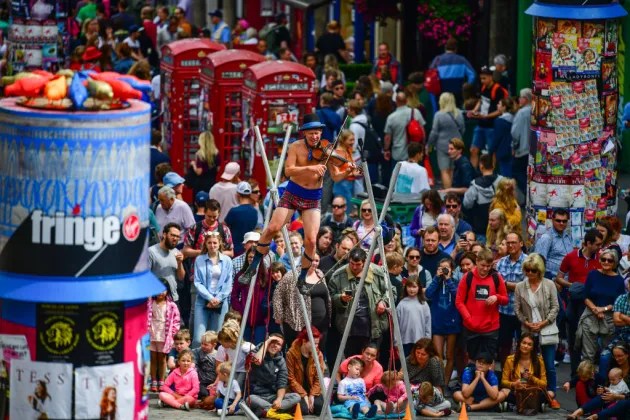
A high number of performers get together at the Edinburgh Fringe every summer.

The world of the arts is one of inequalities: very few do extremely well, and most do badly. It’s on show now at the Edinburgh Fringe, and it proves that celebrity is almost accidental, writes Paul Ormerod

The Edinburgh Festival is in full swing and the number of performers is almost incredible: the overall total this year is estimated to be around 50,000.

A small fraction are already established names; an even smaller fraction may become famous as the festival unfolds. But most will return home just as unknown as when they arrived.

There was an outpouring of support – and subsequent publicity – for performer Georgie Grier after she tweeted that only one person had turned up to watch her show. She now seems to have become something of a celebrity and wound up performing to a packed house.

This is very much the exception rather than the rule. Those responding to the tweet had not seen Georgie’s show; they would have been completely unaware of its inherent quality. So following basic rational choice theory, in which people evaluate the attributes of a product or service and see how it matches their own preferences before forming a view, endorsing the show makes little sense.

This small vignette tells us a great deal about the artistic sector as a whole. The arts are inherently massively inegalitarian. A select few do extremely well and most do badly, very badly indeed.

The work of Duncan Watts helps us understand why this is the case. Watts, who was originally at Columbia University, went on to be paid huge salaries by Yahoo and Microsoft and is now ensconced back in academia.

Read more

It’s not just Jason Arday, most of sociology is a scam

Jason Arday smiling, wearing academic regalia with a blue cap and gown with red accents.

Twenty years ago he published a paper in the prestigious Proceedings of the National Academy of Sciences with the title “A simple model of global cascades on random networks”.  

Watts set up a computer model in which the agents could make one of two choices. For example, you could either go or not go to a particular show at the Edinburgh Festival. Your decision to go wouldn’t be based in any way on the quality of the show; it would be determined by the proportion of people who have seen the show and could influence your choice. Given Grier’s experience, this seems a perfectly reasonable assumption to make.

Watt’s model started with no one having been to the show. Then a few are selected at random to go. Watts then measured, across a large number of individual solutions of his model, how many eventually went. In any context in which the opinions of others have a strong impact on the choices a person makes, the eventual outcome will be very unequal.

The results were intriguing. Most of the time, very few people would go. But very occasionally, huge numbers do. This is exactly like the real life outcomes in the arts.

Watts then followed it up a few years later with some experiments. He got a group of students to listen, one at a time, to 48 music tracks and to rate them and select the ones they really liked. In one set, they just listened to bits of the music. Overall, some were more popular than others, but none stood out dramatically. In another set, students were told what others had selected before them. In this case, a few were hugely popular and most were not. The choices of others had a dramatic impact on the outcome.

This inequality is a deep seated feature of any part of the economy in which the choice which you make is significantly affected by what others do – especially the arts.

Read more

The answer to regional inequality isn’t public money, it’s productivity

Two men setting up a black banner with 10 NORTH in white text on a grey patterned carpet.

Share this article

  • Facebook
  • X
  • LinkedIn
  • WhatsApp
  • Email

Similarly tagged content:

Sections

  • Opinion

Categories

  • Opinion

Trending Articles

  • Iceland boss Richard Walker vows to set up shop on Falkland Islands

  • Britain ‘taxing itself to death,’ Burnham warned

  • £74m for branded condoms? UK must stop spaffing cash on foreign aid

  • Don’t underestimate the free trade agreement Britain just joined

  • As it happened: FTSE 100 inche up as oil holds gains; Healey says UK paying ‘Truss penalty’

More from Morning Wire

  • It’s not just Jason Arday, most of sociology is a scam

    Opinion
    Jason Arday smiling, wearing academic regalia with a blue cap and gown with red accents.
  • The answer to regional inequality isn’t public money, it’s productivity

    Opinion
    Two men setting up a black banner with 10 NORTH in white text on a grey patterned carpet.
  • What to do in London this autumn, from festivals to art and theatre

    Life&Style
    Meatopia event collage: grilled meat, a dish with vegetables, and two smiling women
  • The only answers to over-tourism are prices or queues

    Opinion
    Tourists photograph the ornate white marble Trevi Fountain in Rome, Italy.
  • Josh Kerr took the mile record. But how much further can we go?

    Opinion
    Josh Kerr celebrates new mile record 3:42.66 on Omega scoreboard, Union Jack visible, track stadium background.
  • On this day: ‘We begin bombing in five minutes’ – Reagan’s accidental broadcast

    Opinion
    Ronald Reagan at a podium in Washington in 1982, pointing to his right while speaking.
  • Anthony Hamilton’s cars – including a special jaguar – just sold for £2.9m, here’s why

    Life&Style
    Light blue David Brown Automotive Speedback GT sports car, front 3/4 view, at an auto show display.
  • Why Liverpool deal proves demand for Premier League stakes is soaring

    Sport Business
    Liverpool FC fans cheering in a stadium, holding up red scarves and wearing team jerseys.
MorningWire

Independent European business, markets and political news for decision-makers.

Morning Briefing

Europe

  • Germany
  • France
  • EU Institutions
  • Europe

Business

  • Markets
  • Business
  • Economy
  • Regulation
  • Competition
  • Public Affairs

Editorial

  • Opinion
  • Editorial Policy
  • Corrections
  • Contact

Company

  • About Morning Wire
  • Privacy Policy
  • Terms of Use
  • Cookie Policy
© 2026 Morning Wire Ltd · Published by Morning Wire Media, Bahnhofstrasse 65, 8001 Zürich, Switzerland
Privacy · Terms · Cookies · Facebook