‘Election bot takeover’: Could you tell a real Rishi from a fake?

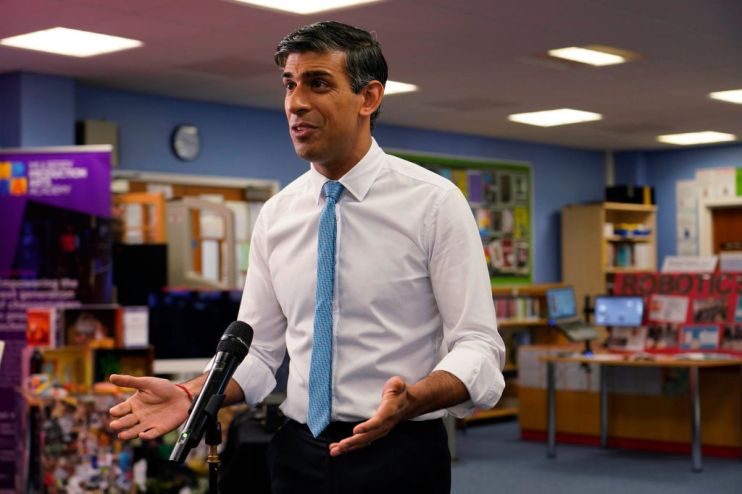
Could bots and deepfakes steal the next general election?
That’s what the National Cyber Security Centre (NCSC) warned yesterday. The UK agency said the next UK general election in 2024 is at risk of being swayed by the ominous presence of deepfakes, which can be generated by artificial intelligence (AI).
These highly convincing computer-generated videos or audio clips can imitate a person’s appearance and voice with remarkable accuracy — and are often used to target high-profile figures like politicians.
In its annual review of cybersecurity challenges, the NCSC, an arm of GCHQ, highlighted the potential for increasingly realistic deepfake videos and other disinformation tactics designed to influence voters.
“While the UK’s use of paper voting in general elections makes it significantly harder to interfere with our elections, the next election will be the first to take place against the backdrop of significant advances in AI,” the NCSC said.
“But rather than presenting entirely new risks, it is AI’s ability to enable existing techniques which poses the biggest threat.”
Among the concerns raised by the NCSC are the rapid dissemination of fabricated online posts and the swift spread of deepfake campaigns across social media platforms.
Tim Ayling, vice president of EMEA at Imperva, a cybersecurity software company, urged the government to prepare for a potential “election bot takeover”.
“Bad bots are getting increasingly sophisticated and harder to detect, so an election will be rich pickings for these AI-created, hyper-realistic bots to spread disinformation and deepfakes,” he said.
He has “no doubt” that the number of bots will increase from 2022 levels when nearly half of all internet traffic comes from bots.
The nasties are also tricky to file a lawsuit against. “The internet is borderless and so any country-specific law will be difficult to enforce if the bot operator is based in a different jurisdiction,” Ayling explained.
But Oliver Lock, Associate, Reputation Management, Farrer & Co, believes deepfakes are a “very real threat” and laws targeting them are “inevitable”.
California has one law already that prohibits the dissemination of deepfakes 60 days before an election.
“It is not inconceivable to imagine a scenario in which a politician dismisses true content as a ‘deepfake’ in order to deflect criticism. Ultimately, if people believe that they cannot trust what they see and hear, it undermines the reliable functioning of democratic processes,” Lock explained.
Deepfakes, he warned, not only blur the line between real and fake content but also have the potential to manipulate dialogues and mislead election campaigns. The erosion of trust in what people see and hear could undermine the democratic process.
And deepfakes are already rearing their heads on social media. In one example posted on X by Karl Turner, the MP for Hull, Prime Minister Rishi Sunak’s murky pint of beer has been altered. Admittedly, this may not sway a general election but it shows how the technology could easily go unnoticed.
Last month, an audio clip seeming to show Labour leader Keir Starmer swearing at staff went viral, gaining over 1.5m views on X, and prompting cross-party outrage from MPs.
The 25-second recording was posted by an X account with the handle “@Leo_Hutz” that was set up in January 2023. Full Fact said there is “no evidence” the clip was genuine.
The threat of deepfakes could even increase with the arrival of e-voting, according to a senior fraud specialist at identity verification company Onfido, Simon Horswell.
He said: “These have already seen uptake in countries like Estonia, for example using a smartphone and government ID to bind a voter to their electronic ballot.
“However, our Identity Fraud Report findings showed that 80 per cent of attacks on biometric systems were videos of videos displayed on a screen – reinforcing the trend of fraudsters turning to deepfakes or cheapfakes to gain access to personal devices.”
“Should online and digital voting become mainstream in the UK, deepfakes will be a major threat to contend with,” Horswell added.
Onfido’s 2024 Identity Fraud Report revealed a 3,000 per cent increase in deepfake attempts in 2023 due to the growing accessibility of online tools, apps, and generative AI.