Skip to content
Friday 21 August 2026London --:--Frankfurt --:--Zurich --:--
NewslettersSearchEN · DE · FR
MorningWire

European business, markets and politics

FTSE 100
10,816.56
+0.64%
DAX
26,136.56
+0.59%
CAC 40
8,484.43
+0.37%
STOXX 50
6,462.22
+0.63%
  • Europe
  • Markets
  • Business
  • Economy
  • Regulation
  • Politics
  • Opinion
More
GermanyFranceEU InstitutionsCompetitionPublic AffairsBankingTechnologyEnergy
  • Germany
  • France
  • Europe
  • Markets
  • Business
  • Economy
  • Regulation
  • Politics
  • Opinion
  • DE
Tuesday 21 February 2023 9:51 am

Energy crisis: Households braced for £500 annual bill hike as falling gas prices miss price cap deadline

By: Nicholas Earl

Add as a preferred source on Google
More than two-thirds of a government fund aimed at creating thousands of new homes in the UK remains unspent, despite launching over six years ago. 
In 2017, the British government launched a £4.2bn Housing Infrastructure Fund to help unlock 324,000 new homes.

Households face a hefty hike to their energy bills in April, predicts Cornwall Insight, after it warned that the price cap would not fall below the reduced subsidy rate in time for Ofgem’s next update later.

Cornwall Insight expects the price cap to fall from its current record rate of £4,279 per year to £3,294 for the three-month window.

This would be a steep drop off from current levels, but would still be historically very high – with the price cap moving between £1,000-£1,200 per year prior to the industry crisis that saw 30 suppliers collapse and Russia’s invasion of Ukraine which drove gas prices to record highs.

The energy specialist expects the price cap to drop heavily in the second half of the year, when the fall in gas prices will be reflected in season-ahead contracts and hedging – which is how suppliers typically buy energy for customers.

However, this will not be in felt in time for the second quarter update, meaning a challenging period awaits households this spring.
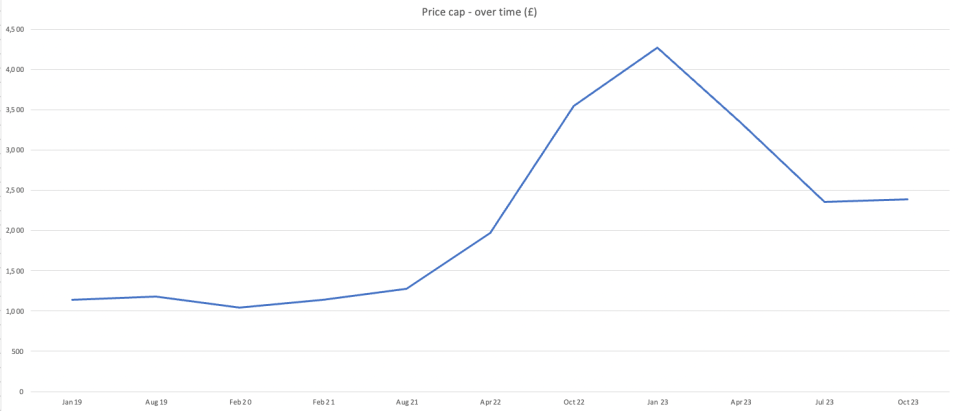
How Cornwall Insight’s predictions will affect gas prices, with pre-crisis energy bills still some time off (Source: Energy UK)

Ofgem is set to announce the cap for the second quarter of the year on February 27, establishing the maximum price for an average energy user on a standard variable tariff from April to June.

With the price cap expected to remain above the subsidy rate of £3,000 per year for the Energy Price Guarantee (EPG) – with Chancellor Jeremy Hunt hiking the protection levels for average bills from £2,500 per year for the next 12 months – many customers will have no choice but to swallow the £500 hike.

Read more

Soaring energy bills set to fuel inflation spike

Smartphone displaying an energy bill notification with British coins and a banknote nearby.

Households are also set to lose out on the £400 saving provided by the Energy Bill Support Scheme, meaning an average £900 per year hike in energy bills is on the way.

Dr Craig Lowrey, principal consultant at Cornwall Insight said: “Regrettably the forecast for April looks set to leave the price cap above the increased Energy Price Guarantee level, meaning average annual consumer bills will effectively jump 20 per cent.

“However, this is before we take into account the end of the £400 energy rebate scheme in March, meaning that the cost of energy for households will increase by even more. While tumbling cap projections are a positive, unfortunately, already stretched households will be seeing little benefit before July.”

Cornwall Insight calculates that the lessened support from the EPG will save the government £2.6bn across the entire scheme.

Based on projected gas prices, if the EPG were to increase to £3,000 per year as planned, the estimated package total would be £26.8bn while if it were to remain at £2,500 per year, the predicted cost for the energy support policies would be £29.4bn.

This is because when the EPG is lower than the price cap, the government has to pay suppliers the difference.

It is currently calculating the price cap will fall to £2,362 in the third quarter, and remain lower at £2,389 per year in the winter.

Read more

‘Door is open’ to interest rate hike as inflation fears return

Bank of England headquarters in 2025, showcasing modern architecture and iconic London skyline in the background.

Share this article

  • Facebook
  • X
  • LinkedIn
  • WhatsApp
  • Email

Similarly tagged content:

Sections

  • News

Categories

  • Energy

Related Topics

  • Energy
  • gas crisis

Trending Articles

  • House prices in wealthy London boroughs fall by up to £300,000

  • As it happened: Miners fuel FTSE 100 recovery; oil jumps as Trump claims Strait of Hormuz

  • City law firm sues prominent Emirati business family

  • Amanda Blanc has worked her magic at Aviva

  • As it happened: FTSE 100 rallies after JD Sports drags on blue chips; oil jumps again

More from Morning Wire

  • Soaring energy bills set to fuel inflation spike

    Economics
    Smartphone displaying an energy bill notification with British coins and a banknote nearby.
  • ‘Door is open’ to interest rate hike as inflation fears return

    Economics
    Bank of England headquarters in 2025, showcasing modern architecture and iconic London skyline in the background.
  • Bank of England to hold interest rates as oil price surge threatens UK economy

    Economics
    Bank of England building on Threadneedle Street, London, showcasing its historic architecture and financial significance
  • Inflation leaps to 2.9 per cent in blow to Burnham 

    Economics
    Burnham cityscape showcasing modern architecture, bustling streets, and vibrant community life in a thriving urban setting
  • Burnham’s cost of living push under threat as oil hits $100

    Markets
    Two men stand in the ocean with multiple oil tankers and cargo ships in the hazy distance.
  • Temporary inflation slowdown set to boost Burnham

    Economics
    Rising inflation graph with increasing percentage symbols, highlighting economic trends and financial market impact
  • Energy operator ‘flying blind’ as net zero push threatens hiked bills and blackouts

    Energy
    Energy prices are high due to a range of factors including volatile gas prices and high net zero levies.
  • ‘False dawn’: June inflation falls to 2.6 per cent but analysts say rises ahead

    Economics
    Till sales growth slowed to 2.7 per cent in the last four weeks
MorningWire

Independent European business, markets and political news for decision-makers.

Morning Briefing

Europe

  • Germany
  • France
  • EU Institutions
  • Europe

Business

  • Markets
  • Business
  • Economy
  • Regulation
  • Competition
  • Public Affairs

Editorial

  • Opinion
  • Editorial Policy
  • Corrections
  • Contact

Company

  • About Morning Wire
  • Privacy Policy
  • Terms of Use
  • Cookie Policy
© 2026 Morning Wire Ltd · Published by Morning Wire Media, Bahnhofstrasse 65, 8001 Zürich, Switzerland
Privacy · Terms · Cookies · Facebook