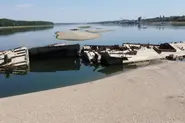
Germany's major rivers are experiencing some of the lowest water levels ever recorded, and the consequences are already reaching far beyond the waterways themselves.
The immediate causes are straightforward: too little rain and too much heat, made worse by successive heatwaves.
As a result, the Rhine, Danube and other rivers are becoming increasingly difficult to navigate, forcing cargo ships to carry smaller loads, disrupting river tourism and raising concerns about supply chains, fuel prices and economic growth.
Stefan Kooths of the Kiel Institute for the World Economy has estimated that the current low-water crisis could reduce German economic output by between €1 billion and €2 billion during the third quarter if disruption continues.
But this is a story about climate and politics as well as economics.
Scientists from the World Weather Attribution group say the current drought has been made more severe by human-caused climate change. Germany's Federal Institute of Hydrology has likewise warned that climate change is expected to make similar low-water events even worse in future.
At the same time, transport authorities, environmental organisations, local government representatives and Green Party politicians are all calling for stronger action, with some accusing Chancellor Friedrich Merz's government of failing to treat the situation with sufficient urgency.
What do the low water levels mean for people in Germany?
The most immediate effects are being felt on the rivers themselves and stretch across much of central and eastern Europe.
Parts of the Danube have fallen to record or near-record lows, leaving boats stranded on sandbanks and disrupting navigation. In Serbia, for example, falling water levels have exposed wrecked Nazi warships in the Danube, creating new hazards for navigation.
But the impact extends well beyond the rivers.
Germany depends heavily on inland shipping, particularly along the Rhine. Because of the low water levels, cargo ships are currently operating with significantly reduced loads. This in turn means higher transport costs and mounting pressure on rail and road networks, which have only limited capacity to absorb additional freight.
Sectors such as chemicals, steel and petroleum are particularly vulnerable but individual consumers could soon feel the effects as well.
For example, economist Thilo Schaefer of the German Economic Institute told reporters that fuel prices may rise if low water levels continue to disrupt deliveries along the Rhine. He noted that similar conditions in 2018 coincided with a rise in average petrol prices in Germany from €1.34 to €1.42 per litre.
Tourism is also feeling the strain. River cruise operators on the Rhine, Danube and Moselle have been forced to reroute, alter or cancel trips, according to the Hamburger Morgenpost. Several companies are already offering customers the chance to rebook as uncertainty grows over whether some journeys can go ahead.
There are broader environmental consequences too. Farmers in parts of eastern Europe fear the effects on crops, while Germany's Federal Ministry for the Environment has warned that warmer rivers can suffer declining water quality and habitat loss.
Low water combined with rising temperatures can also reduce oxygen levels, putting additional stress on aquatic ecosystems.
What are people saying should be done?
Political criticism has become increasingly pointed in recent days.
According to reports in Der Spiegel, the government has issued invitations for an expert conference on the historically low water levels, scheduled to take place on Thursday in Bonn.
But Green Party parliamentary group leader Katharina Dröge has accused Chancellor Merz (CDU) of failing to acknowledge the consequences of extreme heat and climate change, while her colleague Ricarda Lang argues that the government is not taking the climate crisis seriously enough.
North Rhine-Westphalia transport minister Oliver Krischer (Greens) has called for a national task force to address the situation involving federal, state and local authorities alongside the logistics sector.
He is also urging the federal government to provide funding for long-planned river infrastructure projects intended to make the Rhine more navigable during periods of low water.
Shipping organisations are making similar demands. The Federal Association of German Inland Waterway Transport wants bottlenecks on key sections of the Rhine addressed more quickly, while companies are increasingly investing in vessels designed to operate in shallower water.
Others argue that deeper changes are needed. For example, the Nature and Biodiversity Conservation Union of Germany wants landscapes restored so that forests, wetlands and floodplains can store more water and release it gradually during dry periods.
For now, however, there appears to be little sign of relief unless prolonged, widespread rainfall arrives – according to the Federal Institute of Hydrology and the Rhine Waterways and Shipping Authority.