Skip to content
Thursday 10 September 2026London --:--Frankfurt --:--Zurich --:--
NewslettersSearchEN · DE · FR
MorningWire

European business, markets and politics

FTSE 100
10,623.83
-0.43%
DAX
25,530.48
-0.18%
CAC 40
8,165.60
+0.11%
STOXX 50
6,301.86
-0.15%
  • Europe
  • Markets
  • Business
  • Economy
  • Regulation
  • Politics
  • Opinion
More
GermanyFranceEU InstitutionsCompetitionPublic AffairsBankingTechnologyEnergy
  • Germany
  • France
  • Europe
  • Markets
  • Business
  • Economy
  • Regulation
  • Politics
  • Opinion
  • DE
Wednesday 14 December 2022 6:00 am

If we concede to the unions, Britain will find itself in a dizzying wage-price spiral

By: Paul Ormerod

Add as a preferred source on Google
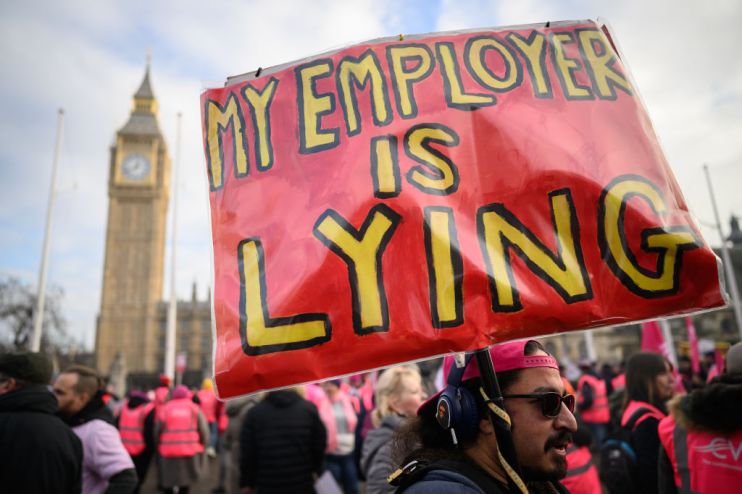
CWU Striking Postal Workers March To Parliament Square
The UK is experiencing quasi "general" strikes. (Photo by Leon Neal/Getty Images) (Photo by Leon Neal/Getty Images)

A wage price spiral. We have not experienced one for so long that for most people the phrase might just as well be written in the Old English of a thousand years ago.  It is, well, sort of comprehensible but only just.

But such spirals can take hold with terrifying swiftness.

Towards the end of 1973, inflation was around 8 per cent.  The figure felt less disturbing then than it does now, after we have experienced several decades of near-zero inflation. The early 1970s had seen a major commodity price boom, pushing up inflation everywhere. In Germany, a country with a longstanding fear of inflation, prices were rising at an annual rate of 4 per cent.

Eighteen months later, by the middle of 1975, inflation in the UK was well over 20 per cent. It was moderated by rising unemployment in the second half of the decade, and even more by the massive recession of the early 1980s with unemployment reaching over 3 million. But it took a further decade for inflation to be really squeezed out of the system.

The trigger for the dramatic acceleration in inflation during 1974 was a sharp increase in world energy prices in the winter of 1973/74.  The potential parallels to the world of today are obvious.

Inflation rose across the West as a whole. But the similarities between countries soon ended.  By the end of 1975, inflation was back down to 4 per cent in Germany and was still some 20 per cent in the UK.

The key difference was that organised labour in Germany – both countries were much more heavily unionised than they are now – appreciated that the rise in world energy prices meant that their living standards had to fall. Income had been transferred from countries which used energy to those which produced it. They did not attempt to chase inflation with ever larger wage demands.

In complete contrast, workers in the UK demanded hefty pay rises. Once conceded, these translated into even higher prices by pushing up the costs of production. In turn, this led to even larger pay claims across the economy as a whole.  The National Union of Railwaymen famously turned down an offer of 27.5 per cent on the grounds that it was inadequate.

Read more

Bank of England’s Pill warns against ‘wait and see’ interest rates approach

Huw Pill, Bank of England Chief Economist, smiling in a suit and tie against a blue NABE banner.

This is what a wage-price spiral looks like. It has a devastating and negative impact on the economy.

We can put this into a much longer historical context. Over the past 150 years, advanced economies such as the US, UK and Germany have only experienced a small number of episodes of high inflation.

Two of these were during the world wars, when the economies were being run at absolutely full tilt and shortages and bottlenecks were everywhere.

The others, such as the 1970s sagas in both Britain and America, have been when there was fierce conflict over the distribution of income.  In Germany in the early 1920s this got completely out of control and inflation was literally millions of per cent a year.

No one is suggesting anything remotely like the hyperinflation of the Weimar Republic will happen. But it is perfectly plausible to envisage inflation remaining in double figures if a wage price spiral develops.

Unionised workers in the public sector and the former nationalised industries such as rail seem completely unwilling to accept that the energy price rise implies a reduction in real wages.  

It’s not just the Conservative government holding the line on public sector pay demands, but Keir Starmer and the Labour Party as well. If we concede, private sector workers will follow suit, and the wage-price spiral will become the norm.

Read more

Food inflation set to surge next year as Iran war ramps up supply costs

Shopper places produce into a cart in a grocery store aisle with mostly empty shelves, indicating supply shortages.

Share this article

  • Facebook
  • X
  • LinkedIn
  • WhatsApp
  • Email

Similarly tagged content:

Sections

  • Opinion

Categories

  • Opinion

Trending Articles

  • Tesco and Boots lead 100,000 jobs pledge to tackle Neets crisis

  • Airport chaos latest: Heathrow, London City ‘starting to recover’ after air traffic control failure

  • Hedge fund billionaire Chris Rokos joins UK wealth exodus 

  • Five lenders hike mortgage prices as interest rate threat looms

  • As it happened: FTSE 100 dives as oil prices surge past $100 in blow to inflation

More from Morning Wire

  • Bank of England’s Pill warns against ‘wait and see’ interest rates approach

    Economics
    Huw Pill, Bank of England Chief Economist, smiling in a suit and tie against a blue NABE banner.
  • Food inflation set to surge next year as Iran war ramps up supply costs

    Retail
    Shopper places produce into a cart in a grocery store aisle with mostly empty shelves, indicating supply shortages.
  • Itsu blames inflation and Labour tax hikes as rising costs bite

    Hospitality
    itsu restaurant storefront with eat beautiful slogan, showcasing Asian salads, sushi, soups, and rice bowls.
  • Inflation expectations softer than predicted ahead of interest rate decision

    Economics
    The Bank of England is expected to hold interest rates at four per cent due to stubbornly high inflation.
  • How patient can the Bank of England be?

    AD
    Historic Royal Exchange building in London with modern skyscrapers behind, clear blue sky.
  • Shop price inflation hits two-year high as rising energy costs hit consumers

    Economics
    Retail sales slumped in May as tax hikes and economic uncertainty hit shoppers' spending
  • As it happened: Miners fuel FTSE 100 recovery; oil jumps as Trump claims Strait of Hormuz

    FTSE 100 Live
    FTSE 100 stocks rise as Brent crude oil prices jump 1.8% to $104.98 amid Strait of Hormuz tensions and Trumps Iran stance
  • Brits think supermarkets are profiteering – despite slowing food inflation

    Retail
    Shopper with red backpack and blue basket walking through a supermarket aisle filled with groceries
MorningWire

Independent European business, markets and political news for decision-makers.

Morning Briefing

Europe

  • Germany
  • France
  • EU Institutions
  • Europe

Business

  • Markets
  • Business
  • Economy
  • Regulation
  • Competition
  • Public Affairs

Editorial

  • Opinion
  • Editorial Policy
  • Corrections
  • Contact

Company

  • About Morning Wire
  • Privacy Policy
  • Terms of Use
  • Cookie Policy
© 2026 Morning Wire Ltd · Published by Morning Wire Media, Bahnhofstrasse 65, 8001 Zürich, Switzerland
Privacy · Terms · Cookies · Facebook