Interest rates are coming down – but how low will they go?

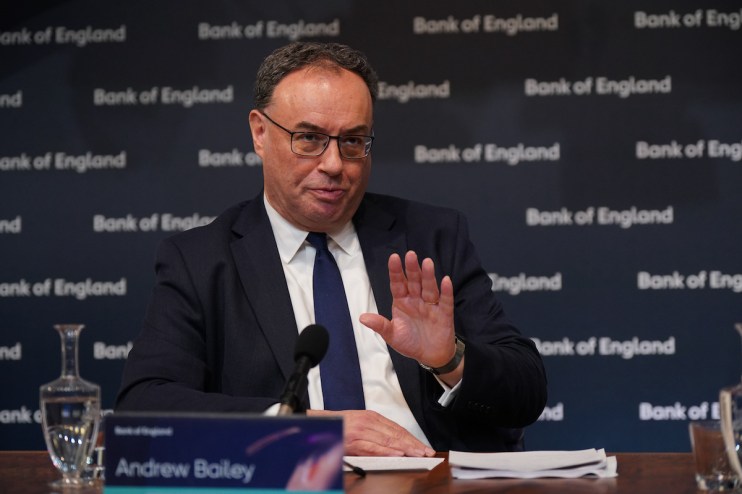
Central bankers could be forgiven for feeling a sense of triumph at last week’s annual Jackson Hole jamboree.
In most advanced economies, inflation has returned to the two per cent target without squashing economic growth. A couple of years ago, when inflation was in the double digits, this would have seemed nothing short of miraculous.
Although economic conditions differ substantially on either side of the Atlantic, central banks are now about to embark on a (relatively) coordinated cutting cycle at or near full employment.
There will be multiple debates over the next few months about how fast and how far interest rates should be cut, but lurking behind many of these debates will be the blurry concept of R*, or the neutral rate of interest.
R* is the interest rate at which an economy operates at full capacity with a steady rate of inflation. It is the Goldilocks interest rate.
There’s just one problem. R* is impossible to measure. Like mystics deciphering the designs of an ineffable God, central bankers can only judge R* through its impact on the economy.
Perhaps unsurprisingly, most rate-setters stay well clear of making any (public) judgement about where the neutral rate might be.
Having said that, R* still guides actions. Despite the handful of rate cuts we have seen, monetary policy remains comfortably in ‘restrictive’ territory. Changes to R* will therefore also change how restrictive or loose monetary policy really is.
So where is R*?
As the UK is a relatively small, open economy, R* will mainly be determined by changes to the global economy.
The most important factor that determines R* is the balance of savings and investment. It is widely argued that R* – both in the UK and around the world – has been on a steady downward trend since the 1970s.
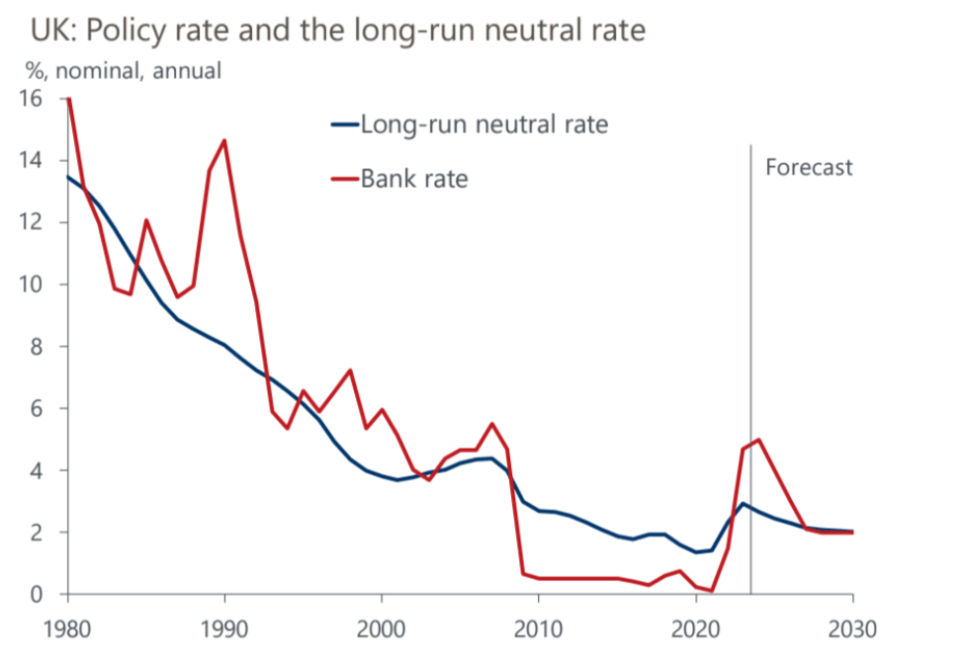
There are two main forces at play here. First, as life expectancy has increased, people have set aside more and more money to enjoy during their retirement. This has pushed up the supply of savings.
Secondly, there has been a prolonged slowdown in productivity growth, which has lowered the return on capital, and thus the demand for investment.
With the supply of savings higher and demand lower, it is no surprise that the price – the interest rate – has fallen. Taking into account the impact of inflation, most economists put the neutral rate at or near zero pre-pandemic.
Since the pandemic, however, most estimates suggest that R* has increased. At first glance, this seems a little odd. After all, why would the pandemic have sent these long-term trends into reverse? Populations are still ageing and productivity growth is still slow.
Part of the answer is due to inflation expectations. Before the pandemic, investors had largely forgotten that inflation existed. Turns out it does. As such, investors now expect a slightly higher return from longer term assets to act as a hedge against the risk of inflation.
It’s not clear if this will be a permanent shift or not, but there are a couple of longer term factors that help explain why R* might be rising.
Given the range of challenges facing advanced economies at the moment, from the green transition to increasing geopolitical tensions, there is likely to be a need for more investment in the years ahead.
According to McKinsey, achieving net-zero by 2050 would require average annual investment to be $3.5 trillion higher than it currently is. That is a very big number which will no doubt impact the neutral rate.
In a speech earlier this year, Isabel Schnabel, a rate-setter at the European Central Bank, said that the “exceptional investment needs… may have a persistent positive impact” on R*.
There’s also the hope that artificial intelligence (AI) might address the long-term slowdown in productivity growth, which would make investment more attractive too. Economists at Goldman Sachs think productivity gains related to AI could help lift global GDP by seven per cent.
In other words, there are some compelling reasons to think the neutral rate has crept up and will continue to do so.
These factors will not be front of mind for rate-setters over the next few months, but they will be hugely important for determining the longer term path of interest rates.