Is it even possible to regulate ‘misinformation’?

It’s easy to call for crackdowns on ‘misinformation’, but how do you actually regulate such an amorphous term, asks Paul Ormerod
Following the publicity given to the murder of Henry Nowak and the actions of the police, all sorts of stories and allegations are flying around social media. Predictably, politicians have not been slow in calling for regulation of what they regard as “misinformation”.
Undoubtedly, a lot of material floating in the ether is just plain wrong. A study of social media posts about local news released earlier this week by the Social Market Foundation (SMF) – hardly a hotbed of pro-regulation thinking – provided plenty of examples.
The assertion that Birmingham Council had stopped conducting meetings in English was widely shared. The SMF argued that 6.5 per cent of news-related posts in the Gorton and Denton by-election amounted to misinformation, including the alleged statement by the Reform candidate Matt Goodwin that “all Mancunians are thick”.
But the fundamental question facing those who demand regulation is: where is the line drawn between an expression of opinion and “misinformation”?
Brexit: A case study in misinformation
An illustration can be given by referring back to the Brexit referendum in 2016, all the more relevant because of Labour’s current revival of interest in forging closer ties, perhaps even rejoining, the EU.
Substantial numbers of Remainers still cannot really come to terms with the fact that they lost. They are so intelligent, so well-educated, so sophisticated, their arguments must surely have prevailed in a fair fight.
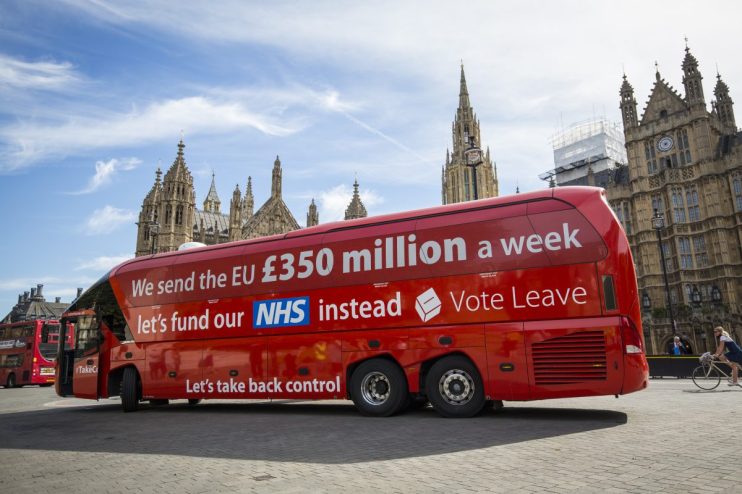
The referendum campaign was obviously a political one, so all sorts of claims were made. A particularly effective one was on the notorious Leave bus, which toured the country emblazoned with the slogan “We send the EU £350 million a week, let’s fund our NHS instead”.
This claim was simply not true, to the extent that the UK Statistics Authority publicly rebuked the Leave campaign.
But the Remain side was equally guilty of gross falsehoods. The Treasury produced a forecast which stated that if Leave won, the economy would enter a recession and unemployment would rise by half a million by the end of the year. This was widely quoted by Remainers in a campaign which the Leave side dubbed “Project Fear”.
In reality, there was no recession. And unemployment, far from rising by half a million by the end of 2016, ended the year lower than it was immediately before the referendum. Indeed, it stayed below the latter level until the onset of the pandemic in 2020.
The warping of forecasts
The Covid period itself provides another example of the difficulty of distinguishing opinion from plain falsehood.
The policy of lockdown was triggered by a forecast made by epidemiologists at Imperial College that without lockdown there would be 500,000 deaths in the UK. This was a reasonable projection on the assumption that behaviour did not change as a result of Covid and that the degree of social mixing remained the same as it was previously.
But the entire history of humanity shows that this assumption does not hold during potentially life-threatening pandemics. Behaviour alters as people try and avoid the plague, whatever it might be. Despite this, we were treated to forecast after forecast of the most dire outcomes if lockdown was either not brought in immediately or lifted if already in place.
On a broader scale, in Stalin’s Soviet Union the population were persuaded that their living standards far exceeded those of the West. But when the Red Army overran Eastern Europe, they saw with their own eyes that this was simply not true. As a result, large numbers of the victorious soldiers were sent to the labour camps to prevent them spreading this “misinformation”.
Many of the examples in the SMF report undoubtedly create the temptation to intervene and regulate. They are provocative. But it is a very slippery slope indeed. Much better to trust in the resilience of democracy.
Paul Ormerod is an honorary professor at the Alliance Business School at the University of Manchester. You can follow him on Instagram @profpaulormerod