Labour isn’t even trying to make its slapdash sums add up
General Elections are always an uncomfortable period for those of us who like our facts straight and our figures honest.
All too often, politicians of all stripes seem to be treating the Liberal Democrats’ infamous bar charts not as a scandal, but an inspiration.
Even by modern standards, however, there is something rather special about the Labour party’s manifesto — and, in particular, its claims to be “fully costed”.
It’s not just the £58bn promise to repay the women who lost out on their state pension due to increases in the retirement age, which suddenly appeared out of nowhere — representing, by the way, the transfer of an indecently large amount of wealth to a generation that is already far more affluent than those below it.
Even on its own terms, the Labour manifesto only balances the books by simply ignoring dozens of spending pledges contained within it.
Shadow chancellor John McDonnell has form on this. Back in 2017, Labour’s first “fully costed” manifesto contained — by my count — roughly 80 spending commitments, some of them substantial, and most completely ignored in the accompanying spreadsheet.
This time round, the Conservatives have released an attack document pointing out 68 omissions in terms of day-to-day spending commitments that Labour has promised but not costed — many of which are very expensive indeed.
And that’s not even including a host of other big-ticket items.
Alongside £80bn extra a year in tax and spend (plus the unknown cost of those 68 other pledges), Labour has already promised £400bn in capital investment. This is a gargantuan sum.
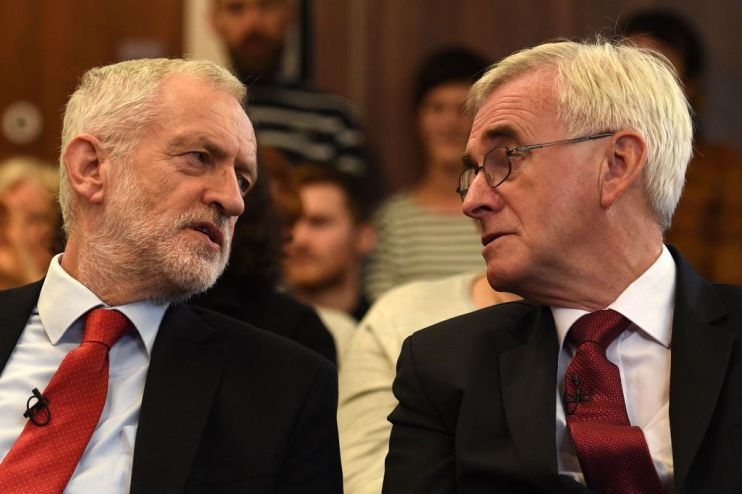
Add to that another £300bn in upfront borrowing costs for renationalising the utilities, plus whatever it would take to grab BT Openreach to create a nationalised broadband service, as Jeremy Corbyn enthusiastically announced.
Then an extra £190bn in loans to homeowners to insulate their houses. And another £75bn borrowed from the private sector to build new wind farms. Top it all off with the cost of actually paying interest on all this borrowing.
It may be that the bond markets prove superhumanly tolerant of the Corbyn-McDonnell regime. But even if so, it is very hard indeed to see how these sums can be absorbed purely via extra taxation on “the rich” and “the corporations”, as McDonnell promises.
In fact, it’s downright impossible — as Corbyn eventually admitted while being grilled-slash-flambéed by Andrew Neil.
Perhaps my favourite example of Labour’s slapdash attitude towards its sums comes from its promise to introduce a four-day week over the coming decade.
Research by our think tank, the Centre for Policy Studies, found that to do this tomorrow, it would cost £45bn a year in extra staff costs for the public sector. If you waved a magic wand and assumed significant productivity gains, it might get you to a mere £17bn.
But rather than taking the easy way out and saying that the four-day week was an ambition over a decade, not a concrete pledge, Labour instead made the genuinely lunatic argument that the policy would entirely pay for itself due to productivity gains.
Average productivity gains in the public sector over the last 20 years stand at 0.2 per cent a year. For the Labour measure to pay for itself, productivity would have to increase at 10 times the rate over the next 10 years.
The best part of this is that Labour’s own report on this issue — commissioned from the venerable left-wing economic historian Lord Skidelsky — accepts that any such productivity gains will largely be driven by automation: firing people and buying PCs.
But Labour’s own manifesto contains a range of measures to slow or actively halt the march of automation in the workplace, ranging from a massive expansion of union power to a new process of “collective consultation” whenever bosses want to introduce labour-saving technology. In other words, a right of robot refusal.
Still, let’s say that Labour’s miraculous productivity gains did appear, despite decades of public sector precedent, the party’s union-friendly desire to restrict automation, and the actual findings of its own report.
For the claim about productivity gains paying for a four-day week to stack up, Labour would have to devote every ounce of benefit from this miraculous tenfold public sector productivity boost to cutting workers’ hours — at the expense of making improvements for the people who actually use those services, or indeed of raising pay for workers rather than cutting their hours.
I know we’re all used to politicians being vague about their figures. But it’s pretty depressing when they don’t even try to make it convincing.
Main image credit: Getty