Skip to content
Thursday 10 September 2026London --:--Frankfurt --:--Zurich --:--
NewslettersSearchEN · DE · FR
MorningWire

European business, markets and politics

FTSE 100
10,670.06
-1.31%
DAX
25,576.45
-1.66%
CAC 40
8,156.67
-1.94%
STOXX 50
6,311.56
-1.58%
  • Europe
  • Markets
  • Business
  • Economy
  • Regulation
  • Politics
  • Opinion
More
GermanyFranceEU InstitutionsCompetitionPublic AffairsBankingTechnologyEnergy
  • Germany
  • France
  • Europe
  • Markets
  • Business
  • Economy
  • Regulation
  • Politics
  • Opinion
  • DE
Thursday 26 January 2023 5:15 am  |  Updated:  Wednesday 25 January 2023 5:34 pm

Let’s be honest, we might actually save the climate with lab-made meat alternatives

By: Matthew Lesh

Add as a preferred source on Google
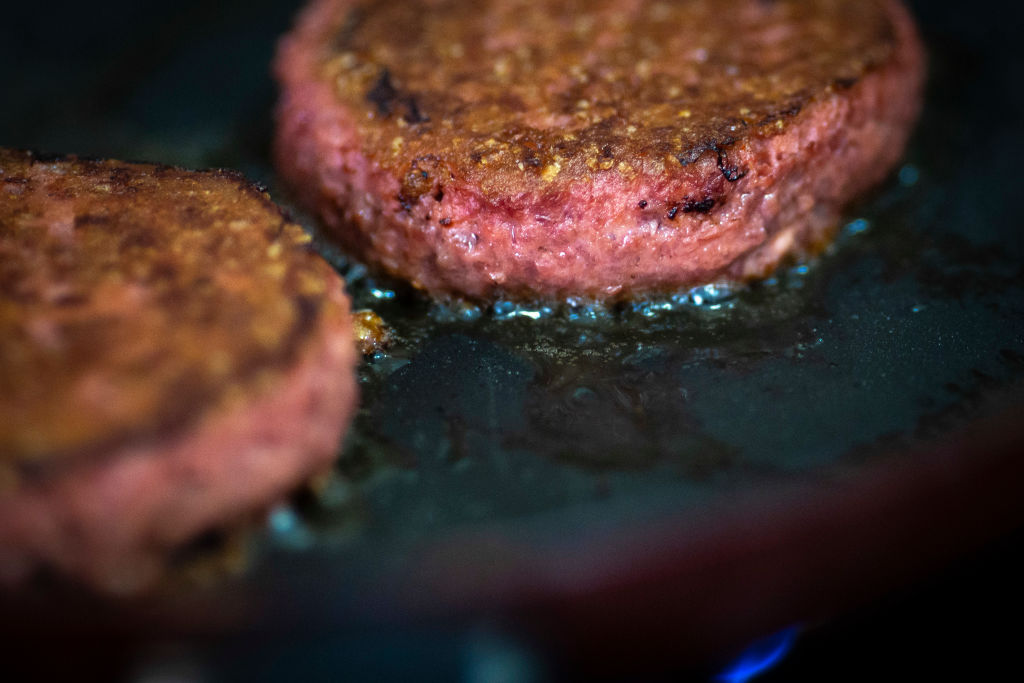
Meatless Burger Maker Beyond Meat's Stock Price Continues It's Skyrocketing Rise Since Its IPO In May
Meat-free meat could make a huge difference in the amount of human-induced greenhouse emission we produce. (Photo Illustration by Drew Angerer/Getty Images)

Wanna save the planet? Lab-made meat could be a good place where to start, writes Matthew Lesh

The conversation turned to travel during an awkward first date a few years ago. “I refuse to fly because of the environment,” he told me. “A recent trip to Sweden by train only took 24 hours.” I immediately raised an eyebrow: a trip back to visit my family in Australia without a plane would involve the Trans-Siberian railway or the Suez canal. There was no second date.

Many in the environmental movement embrace this kind of puritanical attitude. They think the only righteous personal response to the climate crisis is to give up air travel, never use plastic, turn vegan and cycle everywhere. The only government response involves taxes and bans, often couched in Orwellian language around “enabling” consumers to take “concrete actions” for the climate.

Some people are very willing to make lifestyle sacrifices. But it’s foolish to presume that this alone will make the real difference.

Let’s take the case of meat. Livestock farming is responsible for about 15 per cent of human-induced greenhouse gas emissions. It also involves substantial land use, deforestation, habitat and biodiversity loss, pesticides, and pollutants. Not to mention the mistreatment of animals in industrial processes and health and food security risks, including disease and antibiotic resistance.

All of these downsides have been known for a long time – so then, what’s happening with meat consumption? It has quadrupled since the 1960s. It is expected to keep increasing over the coming decades as countries climb the development ladder. Even here in Britain, only 5 per cent of people identify as vegan or vegetarian. Studies suggest that the intention to reduce meat consumption rarely translates into behaviour change. Meat taxes are condemned for hurting the poor and are deeply unpopular.

Even if we feel we should resist our carnivorous urges, we don’t. But perhaps all hope is not lost. Cultivated meat is an alternative protein, produced in vitro using animal cells, that can replicate conventional meat’s sensory and nutritional profile. The first cultivated product was approved for sale in Singapore in 2020, while the United States Food and Drug Administration has just done the same.

We are in the foothills of a food revolution that could significantly alleviate the environmental and animal welfare links to livestock farming. But there’s a catch. Red tape risks delaying, if not preventing, this opportunity in the UK and EU. The novel food regulations, retained in UK law after Brexit, embody the precautionary principle. As a result, it takes an average of 35 months and hundreds of thousands of pounds to get approval; it is unclear what is expected, and an application can be delayed indefinitely. This uncertainty risks sending British innovators away, to other jurisdictions.

There is a long history of new technologies making older ones obsolete. The motor vehicle replaced the horse-drawn carriage, saving city streets from piling up with – literal – faeces. Plastic replaced ivory, saving elephants. Petroleum replaced whale oil, saving the species from extinction. Lab-grown meat could replace livestock farming, saving – or at least playing a part – our environment from such a high percentage of greenhouse gas emissions. It’s surely the kind of innovation even people not willing to travel to Scandinavia by rail could get behind.

Read more

The Burnham bounce won’t last unless Brits get better off

Andy Burnham smiling and holding a pint of beer and a smartphone in a pub setting

Share this article

  • Facebook
  • X
  • LinkedIn
  • WhatsApp
  • Email

Similarly tagged content:

Sections

  • Opinion

Categories

  • Opinion

Trending Articles

  • Tesco and Boots lead 100,000 jobs pledge to tackle Neets crisis

  • Airport chaos latest: Heathrow, London City ‘starting to recover’ after air traffic control failure

  • Hedge fund billionaire Chris Rokos joins UK wealth exodus 

  • Five lenders hike mortgage prices as interest rate threat looms

  • As it happened: FTSE 100 dives as oil prices surge past $100 in blow to inflation

More from Morning Wire

  • The Burnham bounce won’t last unless Brits get better off

    Opinion
    Andy Burnham smiling and holding a pint of beer and a smartphone in a pub setting
  • Reform’s funding scandal is scaring away the very voters it should be appealing to

    Opinion
    Nigel Farage in a light blue suit and red polka-dot tie, speaking at the Reform conference
  • Giving up vegan arm helps Britain’s biggest meatpacker eye profit surge

    Markets
    Assortment of fresh red meat cuts, including steaks and roasts, displayed in a butcher shop or supermarket cooler.
  • Dante Mayfair at Claridge’s review: How about a five-martini dinner?

    Life&Style
    Elegant Dante Mayfair dining room with green booths, marble tables, floral centerpiece, and stained glass ceiling.
  • The City may not be woke, but is it waking up to wellness?

    Opinion
    Men in swim trunks practicing yoga in a park, performing cobra pose on mats.
  • CoStar Data Shows Strong Prelet Activity Driving UK Lab Space Demand to a Record High

    Business Wire
  • Wine to buy this week: The very best Pinot Noir on the shelves

    Life&Style
    Wine bottles and hanging glasses on a dark wooden rack, suggesting a selection of Pinot Noir to buy.
  • We take a food and drink Odyssey through the Square Mile

    Life&Style
    Libby in a warrior costume with a helmet, holding a glass of red wine, with an ancient ship and people in background.
MorningWire

Independent European business, markets and political news for decision-makers.

Morning Briefing

Europe

  • Germany
  • France
  • EU Institutions
  • Europe

Business

  • Markets
  • Business
  • Economy
  • Regulation
  • Competition
  • Public Affairs

Editorial

  • Opinion
  • Editorial Policy
  • Corrections
  • Contact

Company

  • About Morning Wire
  • Privacy Policy
  • Terms of Use
  • Cookie Policy
© 2026 Morning Wire Ltd · Published by Morning Wire Media, Bahnhofstrasse 65, 8001 Zürich, Switzerland
Privacy · Terms · Cookies · Facebook