Let’s be honest, the UK will never grow all its own food – nor should it

By scaremongering about food security and promising to protect farmers in new trade deals, the Prime Minister is simply pandering to vested interests, says Matthew Lesh
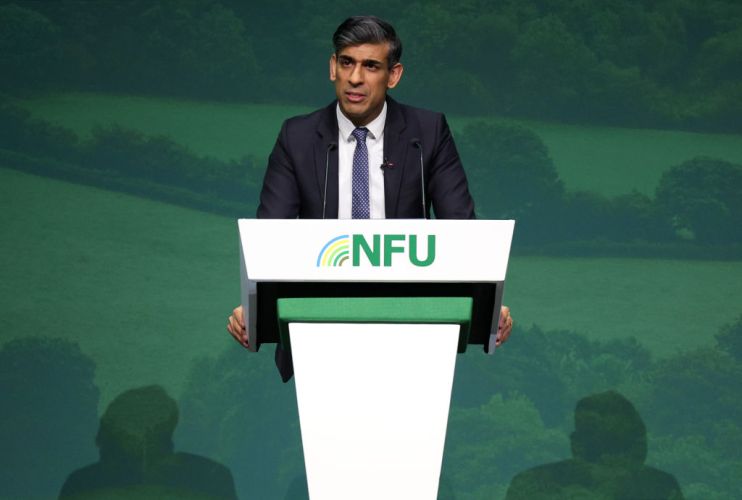
Rishi Sunak expressed concern about the UK’s lack of self-sufficiency in food at the National Farmers’ Union (NFU) annual conference this week. “Food security is a vital part of our national security,” he declared. The Prime Minister, who also said he had “once milked a cow,” has promised to maintain subsidies at £2.4 billion a year and deliver pro-farmer trade deals.
Brexit, the pandemic, and the war in Ukraine have raised fears about the UK’s access to food. Global supply chains have sometimes appeared fragile, and food prices have shot up. Nevertheless, the idea that the UK should shut itself off from the rest of the world in favour of domestic producers is nothing short of ludicrous. It would mean higher food prices, less choice and significantly increased risk of shortages.
Britain has been a net importer of food for centuries. Despite almost three-quarters of our land mass being taken up by agricultural production, nearly half of the food we consume comes from offshore. It would likely be physically impossible for UK farmers alone to produce everything that we eat and many staples of modern diets would disappear without imports.
Half of all vegetables and an astonishing 93% of fresh fruit, such as bananas and avocados, come from abroad. Imports also enable Brits to eat fruits and veggies out-of-season, like tomatoes and strawberries, which can be found on shelves throughout the year. Even for dairy and beef, where the UK produces enough domestic volume to fulfil demand, we still import significant quantities of higher-value products and send the lower-value domestic production offshore.
This level of imports gets hearts racing about food security. But it shouldn’t. It’s the diversity of supply that enables supermarket shelves to be full. A government report published in October last year made precisely this point: “Over-reliance on one geographical area and dependence on particular supply sources makes food supply more vulnerable, while diversity of sources makes it more resilient.”
Do you remember the great wheat shortage of 2020? Probably not, because despite the UK’s wheat yields diving by 40% due to lousy weather, prices barely went up (by 8% year-on-year). This was because the UK could still import wheat from other parts of the world, with the quantity imported jumping from 988,000 tonnes in 2019/20 to 2.3 million in 2020/21. Bad flooding over recent months could make it another challenging year for domestic food production. But once again, imports will guarantee Britain’s food security.
In recent years, the NFU has aggressively campaigned against Australian and New Zealand free trade deals and the prospect of Canadian pork and Mexican beef imports. This is entirely unremarkable. The NFU is a self-interested lobby that wants to keep prices high for their members. The role of political leaders is to represent the public and the most vulnerable, who are struggling with the cost of food.
This dynamic is nothing new. In the 19th century, large aristocratic landowners sought to maintain the Corn Laws, which placed heavy taxes on the importation of foreign grain. The Anti-Corn Law League made the moral case for cheaper bread to feed the starving poor – and won.
Sunak’s Conservative predecessor, Sir Robert Peel, was willing to take on the self-serving landed interests in the name of the hungry masses. In his resignation speech, Peel celebrated the “abundant and untaxed food, the sweeter because it is no longer leavened by a sense of injustice.” Sunak has to choose; will he be on the side of justice and food security or that of a vested interest?