On this day: Big Bang hits the Square Mile

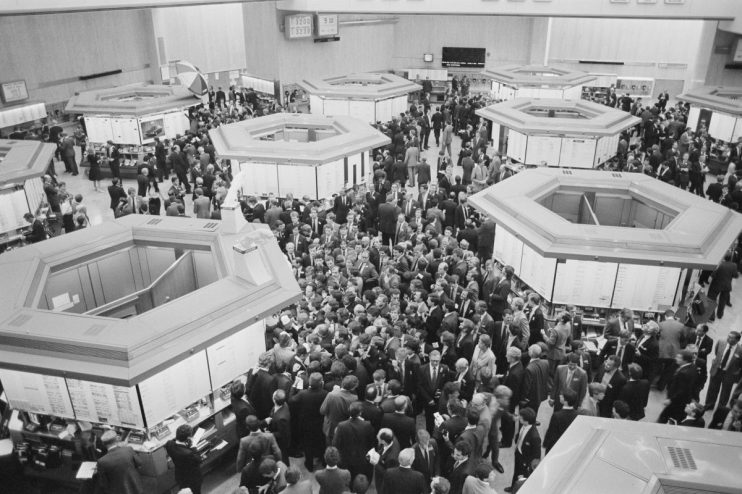
On this day, 27 October 1986: Big Bang hits the Square Mile, and changes the City forever. Eliot Wilson takes us through the financial revolution
By the autumn of 1986, Margaret Thatcher had been in power for seven-and-a-half years, thanks to two successive general election victories. Her tenure had already beaten every Prime Minister of the century except Asquith, Churchill and Wilson. For more than three years, her Chancellor of the Exchequer had been the clever, forceful, no-fools-suffered Nigel Lawson, and his Budget of March 1986 had trumpeted reform and “popular capitalism”.
There was no sense that the Thatcher revolution was complete, however. The Prime Minister, always conscious of her provincial, lower middle-class roots, had a passionate hatred for vested interests and privilege. Even in the mid-80s, one striking example of these was the London Stock Exchange (LSE).
For a century after the Royal Exchange had first opened in 1571, stockbrokers had not been allowed within its precincts because they were regarded as too noisy and vulgar. Instead they had taken their business to coffee houses, especially Jonathon’s Coffee-House on nearby Exchange Alley. Such attitudes died hard. Women and foreign-born traders were only admitted to the Stock Exchange’s trading floor in 1973; and it was indicative that the chairman of the LSE from 1976 to 1986 was Sir Nicholas Goodison (Marlborough; classics at King’s College, Cambridge), who collected 18th century clocks and came from a stockbroking family.
The LSE was old-fashioned and fading. The world’s largest market was the New York Stock Exchange, and London was only a sixth of its size. The abolition of foreign exchange controls in 1979 had seen more and more UK share dealing flow across the Atlantic, and the LSE was severely undercapitalised.
Change was coming, whether the Stock Exchange liked it or not. Just before the 1979 general election, the head of the Office of Fair Trading (OFT), Gordon Borrie, a barrister and former Labour parliamentary candidate, referred the Rules of the LSE to the Restrictive Practices Court. The OFT particularly objected to the system of fixed minimum commissions, but it was also examining the “single capacity” rule separating brokers and jobbers, and the requirement for both to be independent rather than part of a larger group.
Goodison was a public-school aesthete but he did not want for shrewdness. After the Conservatives’ 1983 election victory, he wrote to the incoming (and within months outgoing) trade and industry secretary, Thatcher’s dauphin Cecil Parkinson, with a proposition: if the OFT dropped its investigation, the LSE would reform itself. Fixed commissions would go, and international financial institutions would be admitted, all with a deadline of 31 December 1986.
In March’s Budget speech, Lawson had alluded to the coming changes: “Competition in financial services nowadays is not continental, but global. The City revolution now under way, due to culminate in the ending of fixed commissions, the so-called big bang, on 27 October, is essential if London is to compete successfully against New York and Tokyo.”
What changed after Big Bang?
On this day in 1986, the changes took effect instantly, and Monday 27 October would forever be remembered as “Big Bang”. Fixed commissions were abolished, the separation between traders and advisers was swept away and foreign firms were permitted to take ownership of UK brokers. Another change was startling: the LSE moved from open outcry to screen-based trading.
One broker, Alasdair Haynes, later recalled: “I was used to the hustle and bustle, the crowd on the floor. And on the Monday there was no one there. There was a complete hush, it was extraordinary.”
The real effects of Big Bang were more profound. With increased competition and changing regulation, the LSE boomed, and by 2006 London could claim to be the world’s financial centre. Electronic trading allowed the Stock Exchange to outpace European competitors, and international banks rushed to invest. Within a year, 75 members of the LSE were foreign-owned, and within a decade, only a handful of the old British houses remained: Cazenove, Schroders, Hambros, Flemings.
Some of the consequences were unseen and adverse. Lawson himself later admitted he “didn’t give… a great deal of thought at that time” to the ending of the separation of high street and investment banks, which he came to consider a moral hazard; banks were not “as careful and as cautious and as prudent as they should be”.
David Willetts, then working in Thatcher’s Number 10 Policy Unit, warned that the deregulation might lead to “unethical behaviour” and “individual financial failures”, but did not expect a “systemic problem”. Some have traced the 2008 financial crisis directly back to the revolution of Big Bang, but the Institute for Economic Affairs rightly counters that it “transferred regulatory responsibility from… independent and private institutions to the state”.
In politics, the question must always be asked: what was the alternative? In the early 1980s, London was bleeding business to New York, and Tokyo was a growing threat. The Office of Fair Trading had its dander up: change was unavoidable.
Nicholas Harris has observed acidly that “while Thatcher had set out to recreate the country of her father – sober, Methodist, Victorian – she ended up creating the country of her son, Mark… a country run for arms dealers and bagmen.” History is never that simple. Thatcher was a Manchester liberal and a social conservative, a communicant Anglican profoundly marked by her Nonconformist upbringing, but she had also been greatly influenced by the thrift and self-help of the Jewish community. In any event, she had not particularly championed Big Bang, and had to be persuaded of its merits by Lawson, Parkinson and Goodison.
Today it is 39 years since Big Bang. It was not a panacea, but the status quo was unsustainable. We can say, however, that despite the global financial crisis, despite dire warnings about Brexit, London is still duking it out with New York to be the world’s financial capital, and the margin is narrow. There is life in the Square Mile yet.
Eliot Wilson is a writer, historian and contributing editor at Defence on the Brink