On this day in 1987: 31 killed in King’s Cross fire

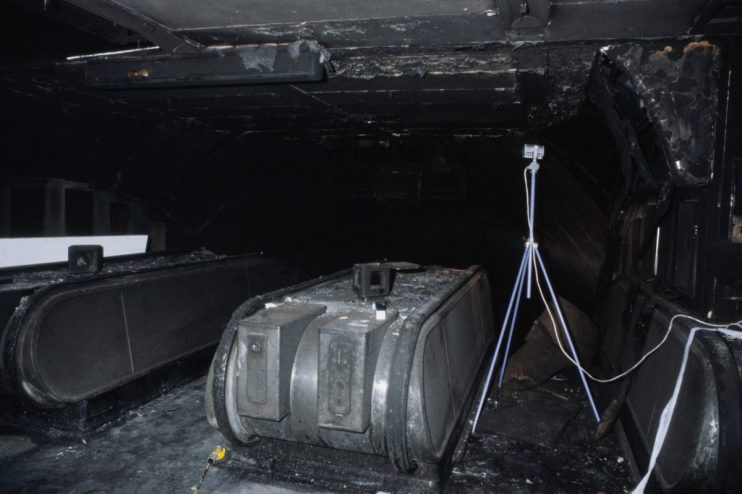
On this day in 1987, a dropped match in King’s Cross Station set a wooden escalator ablaze, costing 31 lives. Eliot Wilson looks back
Smoking on the Tube is incomprehensible to us now. It was prohibited in enclosed public spaces in England in July 2007, and smoking itself has halved in the same time: only one in 10 adults is now a smoker. But in November 1987, London Underground had only recently introduced an experimental six-month ban across the network.
Smoking had been gradually restricted. In July 1984, it had been banned on Tube trains themselves, then in February 1985 in below-surface stations. Passengers had been able to smoke on surface platforms until the middle of 1987; even underground, the ban was not universally observed.
King’s Cross St Pancras blurred those lines: in 1987 it was the busiest station on London Underground’s network, with six Tube lines and innumerable British Rail services. When did underground give way to the surface? Some harassed commuters were dying for a cigarette.
18 November 1987: How the fire started
Wednesday 18 November 1987 had been a drizzly autumn day. It had been a month since the great storm had ravaged the south of England, and the stock market had crashed on Black Monday. The Remembrance Day bombing of Enniskillen in Northern Ireland added to the gloom. Roll on Christmas.
Just after 7.20 pm that evening, a commuter on the Piccadilly line escalator at King’s Cross, deep below the surface, had wanted to smoke. He or she dropped a lit match, and it fell between the treads. At 7.25 pm passengers began to report to London Underground staff that they had seen a fire: the match had set fire to litter and accumulated grease under the escalator – which was wooden. With British Transport Police, staff investigated and confirmed there was a small fire, and a police officer returned to the surface to call the London Fire Brigade. The communications system did not work beneath the surface.
Four fire engines and a turntable ladder were dispatched at 7.36 pm. Three minutes later, the police decided to evacuate the station using the Victoria line escalators. The fire could not be reached with extinguishers, and the station inspector reportedly forgot about the water fog system. Firefighters arrived and assessed the situation: the fire was hard to reach and men with breathing apparatus would use a water jet to bring it under control. Passengers were still leaving the station and trains had not yet been ordered to stop. As the escalator caught ablaze fully, superheated gas rose to the ceiling, where more than 20 accumulated layers of paint absorbed the heat.
At 7.45 pm there was a flashover. A jet of flame roared up the escalator shaft and into the ticket hall, bringing with it choking black smoke. Most of the people still there were killed or horribly injured, including one passenger, 73-year-old Alexander Fallon, so badly burned he would not be identified until 2004. Several hundred people were trapped underground by the inferno and had to be evacuated on Victoria line trains.
London Ambulance Service declared a major accident at 8.16 pm and alerted the capital’s hospitals. The scale was hard to absorb; at 9.11 pm, the Fire Brigade signalled “Make pumps 30” and by 9.32 pm there were 14 ambulances at the scene. At 10.00 pm, Superintendent David Fitzsimons of the Metropolitan Police told reporters, “We are talking about a major tragedy; many people are horribly burned.”
It took until 1.46 am for the fire to be contained, and search and salvage went on all night. 31 people had been killed and more than 100 taken to hospital. Until that day, there had only ever been one fatality due to fire on the Tube, after a blaze on a Central line train near Holland Park in 1958. So how and why did 31 people die that night? Prime Minister Margaret Thatcher quickly announced a public inquiry chaired by senior barrister Desmond Fennell QC to establish what had happened.
Lessons learned after the King’s Cross fire
Fennell’s report, submitted to the Department of Transport in October 1988, was meticulous and exacting, pulling no punches. A litany of failures had led to the disaster: London Underground staff were expected to deal with minor fires themselves but were insufficiently trained, emergency and evacuation procedures were inadequate, wooden escalators and accumulated paint were obvious fire hazards and radio equipment did not work. Sir Keith Bright, chairman of London Regional Transport, and Dr Tony Ridley, managing director of London Underground, both resigned.
Gradually lessons were learned from the King’s Cross fire. Smoking was banned permanently and wooden escalators were phased out; the last example, at Greenford on the Central line, was replaced in 2014. Fire alarms, sensors and CCTV were fitted at Tube stations and hazardous materials were removed. Staff were issued with personal radios but communications remained fragmented – a problem which would come to light amid the horrors of the Tube bombings of 7 July 2005. A fully integrated system was not complete until 2009.
Those responsible for the Tube had essentially never imagined that there could be a catastrophic and horribly lethal fire on the network – until there was. 18 November 1987 was a turning point in safety on London Underground, and excepting the 7/7 terrorist attacks, no-one has been killed by fire since that day. But everything we now know cost 31 people their lives, and we should never forget how high a price that was.
Eliot Wilson is a writer and historian; he is a senior fellow for national security at the Coalition for Global Prosperity and a contributing editor at Defence on the Brink