The advance of India ahead of China offers new ground for a Global Britain

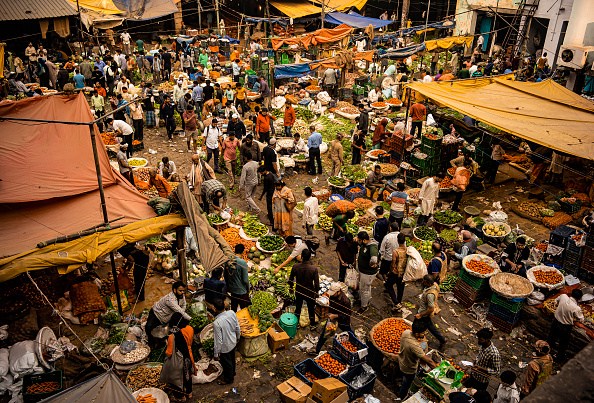
As India overtakes China as the most populous country, the UK should make the most of its historical ties to have influence as Delhi starts to throw Beijing’s power off-kilter, writes Eliot Wilson.
Two weeks ago, a global milestone was passed, with a relatively muted reaction to the changing demographics of the world: India had moved ahead of China to become the world’s most populous nation. The population of India is now estimated to be 1.429 billion, with China lagging behind on 1.426 billion. Together they are home to more than a third of humanity.
This is big news. Since the United Nations started keeping records in 1950, it has been axiomatic that China is the biggest country in the world. Nor is this a blip: China’s demographics look horrible. The fertility rate, at 1.2 births per woman, is among the lowest in the world; nearly 15 per cent of the population is aged over 65; and those aged 25-65 outnumber younger people by two to one. If the worst projections prove correct, the population of China could halve by the end of the century. The train is thundering down the track, and the only question is how big the impact will be.
By contrast, almost all of India’s demographic indicators are positive, and, to invert a recent phrase, it has plenty left in the tank: its population is likely to keep growing for several decades. By 2100, there could be two billion Indians, dwarfing a China subject to ageing and shrinkage. Even in today’s hyper-sophisticated, globally interconnected economy, quantity has a quality of its own.
This doesn’t mean we count China out. It remains a manufacturing giant with strong exports, and its authoritarian government can pull economic levers that democracies could only dream of. But growth has slowed, investor confidence has been dented by repeated lockdowns and state interference in the private sector, and Xi Jinping’s shift in emphasis from growth at all costs to “high-quality growth” has set the country an additional challenge.
In the UK, India is not in especially good odour at the moment. Bilateral friction has been grinding for some time; when the BBC screened a documentary earlier this year which was critical of the prime minister, Narendra Modi, the broadcaster’s offices in New Delhi and Mumbai were raided by tax officials. A government spokesman condemned India: The Modi Question as “propaganda and anti-India garbage, disguised as documentary”.
That will have to be a temporary froideur. In the post-Brexit world, if the government is serious about putting flesh on the bones of “Global Britain” (that ticking time bomb left under UK foreign policy by one Boris Johnson), India must be the lynchpin of our “East of Suez” approach. Our foundational foreign and security policy document, the Integrated Review, was “refreshed” in March, and points the way in some areas: there is a “UK-India 2030 Roadmap”, we are waiting for the eighth round of negotiations over a free trade agreement and we have pledged to support the India’s Indo-Pacific Oceans Initiative. But these institutional bones need an animating spirit.
We have a prime minister whose grandparents were born in India and Pakistan, and a first minister of Scotland whose parents came from Pakistan. There are 1.5 million British Indians. Our relationship, while tangled and full of knots, is a very old one (in fact Iron Age Celts were trading with India). The foreign secretary, James Cleverly, visited India in March for the country’s G20 presidency and made several promising announcements, including that the UK will appoint a tech envoy to the Indo-Pacific. But we need to effect a shift in sentiment too.
Combining blunt pragmatism and a human dose of sentiment is a very British knack, and we need it here. Dry tables and figures will not breathe life into what David Cameron called a “new special relationship”. Somehow, we have to explore the long-standing connections between the UK and India—where English is the second most spoken language—in a way which emphasises the positive aspects while remaining, as one Indian newspaper put it, “authentic”.
If we can find our shared instincts, our common habits of thought and speech and our profound cultural ties, we can breeze past the queue and extend a hand to an old friend which has become the region’s powerhouse: dynamic, young, ambitious, creative and democratic. That prize would be a huge contribution to making Global Britain a reality.