The Bank of England needs to stop rising interest rates to avoid a painful recession
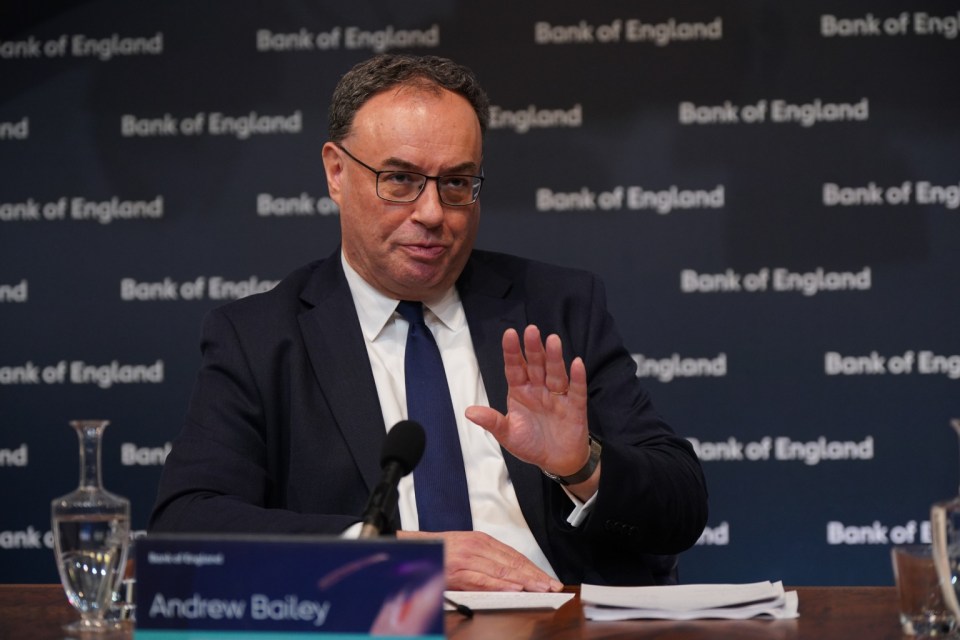
After all the interest rate rises and inflation predictions, the Bank of England risks an unnecessarily deep recession, writes Damian Pudner.
The Bank of England is at a significant crossroads in the wake of the US Federal Reserve and the European Central Bank’s quarter-point interest rate hike.
Today, the Monetary Policy Committee (MPC) is poised to unveil its latest policy decision, an announcement that has stirred considerable speculation, with markets pricing in a 0.25 per cent rate hike.
But there is a rising undercurrent of dissent within the financial and political sectors questioning this apparent consensus among leading central banks.
Of course, the Bank of England has independence over monetary policy decisions, but that mandate to achieve its inflation target is set by the government. Therefore, the Old Lady is still very much accountable to Parliament when it fails to achieve this target.
Over the past two years, the Bank’s inflation forecasting has consistently fallen short, and by a considerable margin, raising genuine questions over its credibility.
As late as the Bank of England’s November 2021 official inflation forecast, the central projection was that inflation would remain at 3.4 per cent in Q4 2022 and 2.2 per cent in Q4 2023. The Bank’s highest (although the least likely) official forecast was for inflation to reach 6 per cent to 7 per cent between Q4 2021 and Q1 2022.
As we know, inflation reached 10.5 per cent at the end of 2022, which means that the Bank’s central – most likely – inflation forecast erred by more than 300 per cent. Of course, the war in Ukraine was not part of the calculations in November 2021, and the ensuing energy crisis has been blamed for the wild underestimations of the Bank of England.
But the MPC has consistently failed to predict or control inflation, and when we eventually learn lessons from the misjudged monetary policies of the Covid-19 pandemic, we must make room for recalibration of the Bank’s decision making.
The Bank will be undertaking a review of its inflation forecasting, led by the former US Fed Chair, Ben Bernanke. The challenge for Professor Bernanke will be enormous. The review should be used to challenge “groupthink” at the meetings of the Monetary Policy Committee, as well as the benchmark model used by the Bank to make its projections; a model that disregards the amount of money as a useful indicator of future inflationary/deflationary pressures.
In the past 18 months, the Bank has progressively tightened monetary policy 13 times, elevating the base rate from almost zero to 5 per cent – its November 2021 Monetary Policy Report forecast Bank rate to remain at 1 per cent between 2022 and 2024.
Furthermore, the Bank is actively withdrawing money with its asset sales programme (so-called “quantitative tightening”), by £80bn per year, with £40bn in active gilt sales and £40bn in naturally maturing gilts that are not replaced.
Until recently, excess liquidity and the surge in personal savings during the pandemic provided a welcome buffer for household budgets. However, the current economic indicators exhibit worrying signs, most notably a contraction in money supply.
By ignoring these warning signs, the Bank might inadvertently lead us into a self-inflicted recession that is more severe, widespread, and enduring than many existing recessionary forecasts suggest. If the Bank wants to reassert its – very much damaged – credibility, it should not tighten monetary policy further.
While additional rate rises that appear to fight inflation may gain the Bank market credibility in the short term, it risks destabilising the economy over the medium to long term even more.
The Bank’s excessive money creation in 2020-21 led to an inflationary boom in 2022. At this stage, a slowdown and a market correction are inevitable. However, we do not want the Bank of England to overcorrect past mistakes and contribute to a longer and deeper recession; ultimately fostering the repetition of “boom and bust” cycles.
Sometimes, to do nothing is the most sensible policy decision.