The Liberal Democrats and the long, hard climb back to political relevancy

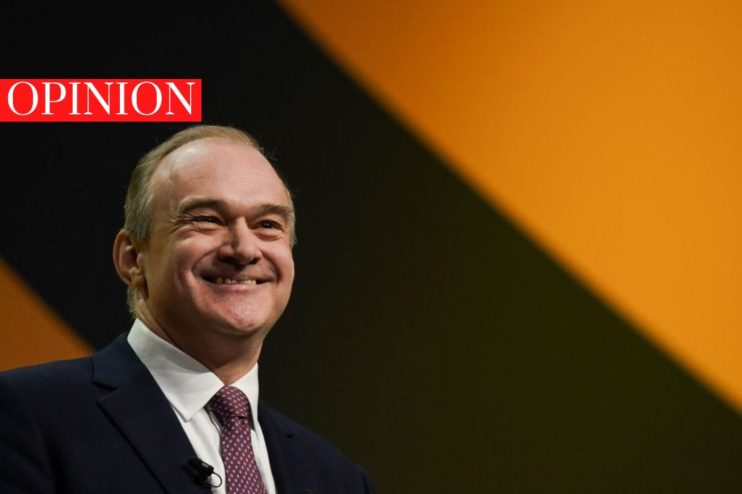
As Keir Starmer looks increasingly likely to be the next PM, Ed Davey’s Liberal Democrats have a shot at power – if they can remind voters they exist, writes Eliot Wilson
If you are the betting kind, a wager on Sir Keir Starmer being the next prime minister will not make you a vast profit. A photo opportunity outside the famous black door of Downing Street next autumn seems overwhelmingly likely. However, if you take Westminster watchers to one side, there is a common reluctance to go much further than that. “Labour will be the largest party,” one told me. “Otherwise, God knows…”
This horror of overconfidence, of arrogance or taking anything for granted, runs deep in Labour’s soul. Although its genuine significance has been overestimated, Labour still have shuddering memories of 1992, and of Neil Kinnock’s toe-curling quasi-victory rally a week before polling day. 10,000 people packed the indoor Sheffield Arena, looking forward to ending 13 years of Conservative rule and to getting the Labour Party back behind the desks of Whitehall at long last. If Kinnock’s mid-Atlantic cry of “We’re all right!” did not in fact bury the party’s chances, it deserved to, and that is how the event will be remembered.
Starmer has ruled out a coalition with the separatist SNP. But he has made no such definitive statement about forming a partnership with the Liberal Democrats, and it is easy to imagine a scenario in which the Lib Dems have the parliamentary numbers to push Labour over the line. Given that, it is only right that we should examine who they are and what they stand for.
You remember the Liberal Democrats. Last time they formed a coalition, in 2010, they had a phalanx of 57 MPs. Today they have only 14, though hope to gain considerably at the general election. Sir Ed Davey has been leader for three years now, and has struggled to make much of an impact. Despite by-election victories in Chesham and Amersham, North Shropshire and Tiverton and Honiton, and a decent showing in the local elections, his party is nationally moribund at around 10 per cent. Where they have done well, it has been, as it usually is with Liberal Democrats, a combination of focusing resources and posing as a nice-enough-person alternative to the Conservatives.
Davey himself has gained little traction. When pollsters mention his name, the “don’t knows” score heavily, and he only makes the headlines when he says something especially controversial, like his declaration earlier this year that “quite clearly” a woman could have a penis. Even so he outstrips his colleagues: some will recognise former leader, now environment spokesman, Tim Farron, a larky evangelical Christian who would look at home supervising a youth group. Very occasionally, sheer persistence will force Layla Moran—Roedean-educated daughter of an EU ambassador—into the public consciousness with a self-declared piece of radicalism such as her pansexualism or support for official recognition of Palestine.
Since their creation in 1988, the Liberal Democrats have occasionally found issues to embrace which extend their appeal well beyond their natural political base. Until the rise of Tony Blair, they subsisted on non-socialist, non-Thatcherite centrism; for the past 20 years, they have identified strongly with opposition to the 2003 invasion of Iraq, opposition to student fees (until they agreed to them), and support for UK membership of the European Union. Now, with Iraq increasingly a generational memory and Brexit here to stay, their cupboard of pleasantries is looking bare.
The Liberal Democrats are long-term enthusiasts for constitutional reform, that most luxurious of parlour games for the bored bourgeoisie. Elections are not won by the allure of the single transferable vote, yet this has emerged as the price they are likely to demand of an aspirant party of government. If Starmer offers progress towards a proportional system of voting, the Liberal Democrats will do almost anything, because they regard PR as their ticket to real power. Despite the devastating effect of participating in the last coalition, from 2010 to 2015, after which they lost 49 of their 57 MPs, they are still addicted to a system which virtually guarantees coalitions.
Ed Davey should remember that; after all, he was one of the unlucky losers, scrambling back into the Commons in 2017. He knows how coalitions work, as a junior minister for employment relations and consumer affairs, then energy and climate change secretary. If he does end up with the numbers to assist the Labour Party in 2024, he should be cautious. He has seen what can come out of coalitions, so he should think very hard about what he can take in. A ministerial Tesla can seem exciting, but you can never know when the journey will end, nor whether you’ll be let out at the kerb, or thrown from a moving vehicle.