Skip to content
Tuesday 18 August 2026London --:--Frankfurt --:--Zurich --:--
NewslettersSearchEN · DE · FR
MorningWire

European business, markets and politics

FTSE 100
10,728.04
+0.07%
DAX
26,128.36
-0.80%
CAC 40
8,509.36
-0.82%
STOXX 50
6,468.17
-0.95%
  • Europe
  • Markets
  • Business
  • Economy
  • Regulation
  • Politics
  • Opinion
More
GermanyFranceEU InstitutionsCompetitionPublic AffairsBankingTechnologyEnergy
  • Germany
  • France
  • Europe
  • Markets
  • Business
  • Economy
  • Regulation
  • Politics
  • Opinion
  • DE
Wednesday 04 December 2019 11:30 am  |  Updated:  Wednesday 04 December 2019 11:46 am

Our divided country can’t even agree on who our enemies are

By: Sophia Gaston

Add as a preferred source on Google
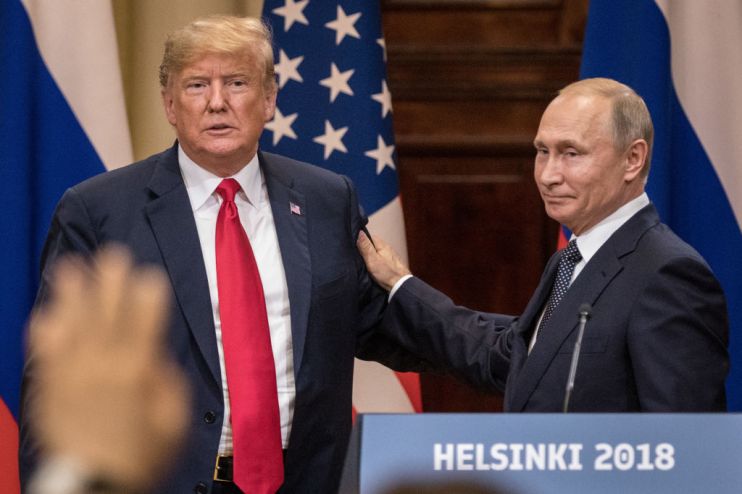
President Trump And President Putin Hold A Joint Press Conference After Summit
Which is the bigger threat to the UK: Russia or the US? Almost a third of Britons now classify America as a menace to the world

Aristotle wrote that “a common danger unites even the bitterest enemies”. So what hope of unity is there for a nation where the very perceptions of danger become contested?

Ahead of this week’s Nato meeting, the British Foreign Policy Group conducted a public opinion survey with pollsters at Opinium, exploring perceptions of the most pressing threats facing Britain and the world at large. 

It reveals a nation starting to pull apart on one of the few areas that once brought us together.

With the brazen Salisbury assassination attempt still very present in British minds, Russia stands apart as the single greatest threat to global peace and security. It is followed by North Korea, Iran, and China — no longer simply regarded as an economic competitor to the UK, but a potentially dangerous autocratic state.

So far, so expected. But strikingly, almost a third of Britons classify the United States of America, our enduring partner in a “special relationship”, as a menace to the world. Concern about America’s influence captures the downward trend in global perceptions of the US since bombastic President Donald Trump took office. 

In Britain, the growing antipathy towards the US reflects the increasingly binary identities that have emerged in the wake of the EU referendum, with politicians presenting a zero-sum choice of a future aligned with either America or the European Union. 

The political divisions are stark. Just six per cent of Conservative voters rank the US as a top global threat, with most regarding it as the key to unlocking the “truly global” potential of Brexit Britain. In contrast, voters intending to support Labour in next week’s election are disproportionately likely to feel anxious about America’s international influence. 

Comparing the views of their voting base in 2017, we can see that the rising concern about America is also matched by a declining degree of concern about Russia — with one of our most established foes now given equivalent status to our long-term friend.

Read more

Could a ‘land blocking’ rule change spell danger for Aldi and Lidl?

Lidl supermarket sign with blue, yellow, and red logo against a clear blue sky

The American antipathy is predominantly driven by older Labour voters, so it is safe to assume that it has been germinating over some time — perhaps with roots in the “betrayal” of the Iraq War. But it also reflects the priorities and worldview of Jeremy Corbyn and his key advisers, who are repelled by the notion of strategic multilateralism, and rather aspire to see Britain’s people and the Labour party itself as instrumental actors in a global socialist movement. 

Through this prism, foreign policy should not be conducted with a balance of interests and values, but solely in pursuit of (seemingly) noble humanitarian causes. 

This dramatic shift in the framing of Britain’s role in the world represents a true step-change, signalling the breakdown of the cross-party consensus that had formed over decades. It is difficult to imagine that this shift in gears would have taken place, nor have been so radical, under a more conventional Labour leader. 

However, it is also true that Brexit, with its breaking down of old alliances, has irrevocably altered the status quo, and forced us to redefine our global footprint — opening the doors to blue sky thinking about our country’s place in the world.

What is most concerning about these developments is not that the British people are being presented with alternatives on foreign policy — we should not be afraid of a robust debate. We should, however, fear a time in which Britons fundamentally disagree about the threats we face as a nation. 

Our shared understanding of our allies and aggressors has given us unity at home and protected our interests abroad. A greater degree of social polarisation on foreign policy will make it more difficult for us to perform effectively on the world stage. 

Most chillingly, if we no longer agree on the enemy outside, we may well find our own enemies within.

Read more

Britain has the lowest level of millionaires since the financial crisis – and that’s no accident

Experts believe an exit tax could stem to flow of wealthy residents leaving the UK

Share this article

  • Facebook
  • X
  • LinkedIn
  • WhatsApp
  • Email

Similarly tagged content:

Sections

  • News
  • Opinion

Categories

  • Business
  • Opinion
  • Politics

Related Topics

  • Donald Trump
  • Vladimir Putin

Trending Articles

  • As it happened: FTSE 100 drops as oil prices rise after Trump makes Hormuz threat

  • Jobless Banquet: Youth unemployment surge ‘sends Neets to KFC’

  • US bond market jitters spark UK economy recession warning

  • Monzo chair makes early exit after boardroom rift

  • Aldi boss wades into supermarket ‘price-gouging’ row

More from Morning Wire

  • Could a ‘land blocking’ rule change spell danger for Aldi and Lidl?

    Retail
    Lidl supermarket sign with blue, yellow, and red logo against a clear blue sky
  • Britain has the lowest level of millionaires since the financial crisis – and that’s no accident

    Opinion
    Experts believe an exit tax could stem to flow of wealthy residents leaving the UK
  • Here’s how to fix London listings

    Opinion
    AIM100 stock market data display showing risers and fallers, with financial charts and percentage changes.
  • Policing alone won’t solve London’s shoplifting epidemic

    Opinion
    Shoplifting incident in retail store with security camera footage showing suspect concealing merchandise in jacket
  • The Burnham bounce won’t last unless Brits get better off

    Opinion
    Andy Burnham smiling and holding a pint of beer and a smartphone in a pub setting
  • The City is awash with talk of an early general election

    Politics
    Andy Burnham speaking passionately at a public event, wearing a suit, highlighting his role as a prominent political figure.
  • SailGP: The $100m-per-team sailing league looking to join British summer of sport

    Sport Business
    Unfortunately, without more specific details or context from the article content, its challenging to generate a precise al...
  • Non-compete clauses are restraining Britain’s talent market

    Opinion
    London office workers collaborating on AI and tech projects, surrounded by computers and digital interfaces in a modern wo...
MorningWire

Independent European business, markets and political news for decision-makers.

Morning Briefing

Europe

  • Germany
  • France
  • EU Institutions
  • Europe

Business

  • Markets
  • Business
  • Economy
  • Regulation
  • Competition
  • Public Affairs

Editorial

  • Opinion
  • Editorial Policy
  • Corrections
  • Contact

Company

  • About Morning Wire
  • Privacy Policy
  • Terms of Use
  • Cookie Policy
© 2026 Morning Wire Ltd · Published by Morning Wire Media, Bahnhofstrasse 65, 8001 Zürich, Switzerland
Privacy · Terms · Cookies · Facebook