Skip to content
Sunday 9 August 2026London --:--Frankfurt --:--Zurich --:--
NewslettersSearchEN · DE
MorningWire

European business, markets and politics

FTSE 100
10,901.09
+0.31%
DAX
26,319.45
+0.69%
CAC 40
8,714.93
+0.17%
STOXX 50
6,523.86
+0.33%
  • Europe
  • Markets
  • Business
  • Economy
  • Technology
  • Politics
  • Opinion
More
GermanyFranceBankingAIEnergyFintechPropertyCapital Markets
  • Germany
  • France
  • Europe
  • Markets
  • Business
  • Economy
  • Technology
  • Politics
  • Opinion
  • DE
Wednesday 04 September 2024 6:00 am  |  Updated:  Tuesday 03 September 2024 8:51 pm

Why home working might be damaging London’s economy

By: Chris Dorrell

Add as a preferred source on Google
Hiring managers struggling with 'demanding' Gen Z
Photo by PA

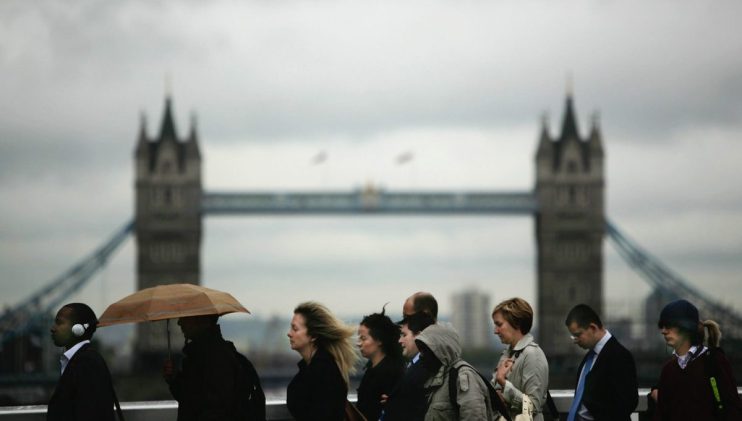
Londoners have been slower to return to the office after the pandemic than workers in many large cities around the world. This really matters, and not just for London.

Almost all of the UK’s economic problems can be traced back to sluggish productivity growth. Productivity, which measures output per hour, is the engine of economic growth.

As Paul Krugman once said: “Productivity isn’t everything, but, in the long run, it is almost everything.”

London has witnessed a sharp slowdown in productivity since the financial crisis, trailing international competitors and even falling behind the national average.

Since the pandemic, this trend has only got worse. According to official figures, output per hour in London was 2.7 per cent lower in 2022 than it was in 2019. This makes it the only part of England to have seen negative productivity growth over this period.

A new Centre for Cities report, released today, suggests that home-working might be part of the explanation for the most recent deterioration in productivity.

The report found that Londoners work an average of 2.7 days per week in the office, just ahead of Toronto but behind the four other surveyed cities. Paris came out on top, with 3.5 days spent in the office.

And while office work has picked up on last year, when Londoners spent 2.2 days in the office, it still significantly lags behind the pre-Covid average.
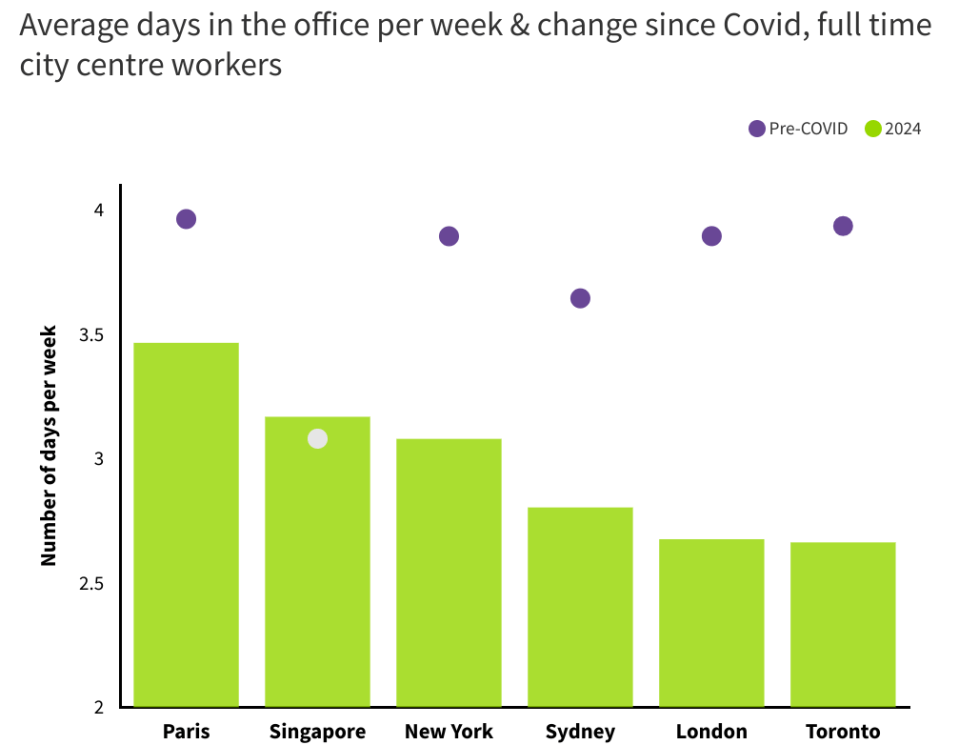
Source: Centre for Cities

Rob Johnson, an analyst at the Centre for Cities told Morning Wire that the direct impact of homeworking on productivity was a “big unknown”, but argued there was good reason to think it had made a difference.

London’s economy is dominated by the knowledge-intensive services sector in which face-to-face interactions are especially valuable for enabling transfers of information and knowledge.

“We know knowledge disseminates and innovation happens through face-to-face interactions,” Johnson said.

Read more

Give London power to level up the rest of the country

Business professionals in formal attire engaged in a lively discussion at a corporate meeting in a modern office setting.

These so-called ‘spillover effects’ make a big impact on an economy. As the report notes, “less frequent face-to-face interaction between employees in central London would put the city at a productivity disadvantage relative to other global cities.”

“We just need to know what the impact is because London’s productivity slowdown is the UK’s productivity slowdown,” Johnson argued.

The concern is that London’s performance might suffer in the long term. Indeed, it is a problem that workers are aware of despite their short-term preference for hybrid working.

A third of workers think they are more productive at home day-to-day, and two-thirds feel more productive at home for at least some of their tasks, the report found.

At the same time, over two-thirds of workers thought that workers spending more time at home over the next five years would have negative impacts. Top of the list of concerns for employees was the potential effect on learning new skills.

So what should employers be doing about it? The report suggests that one of the most effective ways employees could be enticed back into the office is to subsidise the commute.

“London’s workers are by far more likely to cite that travel costs are a barrier to getting back to work than workers elsewhere,” Johnson said.

For example, 42 per cent of Londoners cited lower travel costs as a benefit of hybrid working compared to just 25 per cent of Parisians, the city where most workers have returned to the office.

One big difference is that employers in Paris are obliged to cover a minimum of 50 per cent of what employees spend commuting on public transport. Many cover the entire cost of commuting.

Perhaps London businesses could learn something from their Parisian counterparts.

Read more

FTSE 100 property giants urge Burnham to unleash London office construction

Skyline of Canada with iconic financial district buildings, highlighting UK investments and economic growth.

Share this article

  • Facebook
  • X
  • LinkedIn
  • WhatsApp
  • Email

Similarly tagged content:

Sections

  • News
  • Markets & Economics

Categories

  • Economics
  • Business

People & Organisations

  • London economy
  • productivity
  • UK economy
  • WFH

Related Topics

  • London
  • London business

Trending Articles

  • Thames Water faces fresh threat to survival after pensions regulation breach

  • PwC’s Embankment HQ to get major makeover ahead of Canary Wharf move

  • Family feud: London estate agent Winkworth sues chair over plot with wife to oust son from board

  • As it happened: Stocks rise despite new tensions in Strait of Hormuz; Oil price climbs

  • A tribute to wine legend Matthew Jukes by his friend Libby Brodie

More from Morning Wire

  • Give London power to level up the rest of the country

    Opinion
    Business professionals in formal attire engaged in a lively discussion at a corporate meeting in a modern office setting.
  • FTSE 100 property giants urge Burnham to unleash London office construction

    Property
    Skyline of Canada with iconic financial district buildings, highlighting UK investments and economic growth.
  • Devolution is the shakeup Britain needs

    Opinion
    Andy Burnham speaking passionately at a public event, wearing a suit, highlighting his role as a prominent political figure.
  • Vance says ‘broken’ Britain must rebuild economy, not just change PM

    Politics
    Andy Burnham returns to Parliament
  • London workers most exposed to AI jobs cull

    Economics
    London skyline with modern skyscrapers and lush green foliage in foreground on a clear day, highlighting urban nature balance
  • ‘Good growth in every postcode’? Not in Greater Manchester

    Economics
    Andy Burnham speaking in Manchester, showcasing leadership and urban development initiatives in the city.
  • Singapore on Thames or the Sick Man of Europe?: The Economics of Brexit Ten Years from the Referendum 

    Opinion
    UK-EU Brexit negotiations meeting with officials discussing trade agreements and policy impacts in a formal conference room
  • Four charts revealing scale of Andy Burnham’s economic challenge

    Economics
    Due to the lack of article title, content, categories, and tags, its impossible to create a specific, keyword-rich alt tex...
MorningWire

Independent European business, markets and political news for decision-makers.

Morning Briefing

Europe

  • Germany
  • France
  • Europe
  • UK & Ireland

Business

  • Markets
  • Banking
  • Technology
  • Energy
  • Property
  • Fintech

Editorial

  • Opinion
  • Editorial Policy
  • Corrections
  • Contact

Company

  • About Morning Wire
  • Privacy Policy
  • Terms of Use
  • Cookie Policy
© 2026 Morning Wire Ltd · Published by Morning Wire Media, Bahnhofstrasse 65, 8001 Zürich, Switzerland
Privacy · Terms · Cookies · Facebook