With America divided, the spotlight once again falls on the Fed

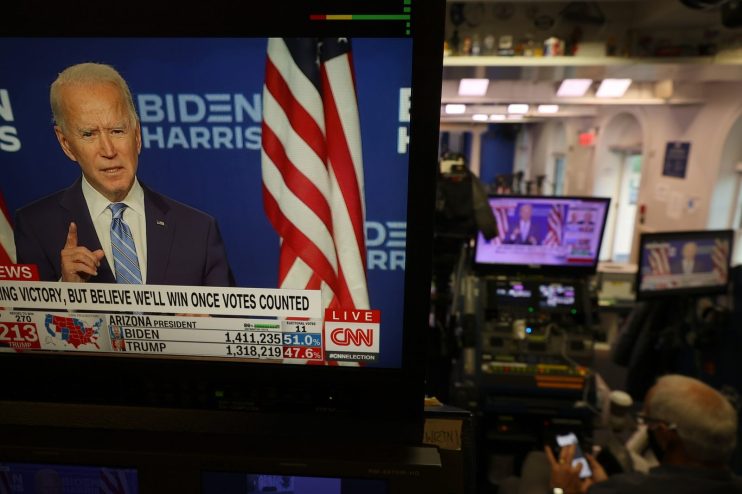
Amid the continued uncertainty of the US presidential election, one thing is clear: Joe Biden’s White House, should he secure victory in the coming days, will struggle to deliver its desired fiscal stimulus package through a Republican Senate.
The US economy’s path through the Covid recession will therefore be shaped by the actions of a Federal Reserve that has just concluded a strategic review of its mandate.
In August, chair Jerome Powell announced that the Fed would shift away from an explicit two per cent target and towards average inflation targeting. The central bank concedes that the relationship between growth, employment and prices is no longer as clear-cut as many macroeconomists and monetary policymakers thought it to be a decade ago.
This represents a reinterpretation of the Fed’s relationship to its mandate.
The central bank has recognised that economic fundamentals and political necessity are different now. It has accordingly redefined and clarified how it intends to apply its mandate, allowing the economy to “run hot” in order to better achieve its twin employment and price stability targets. The Fed’s understanding of maximum employment, and the determinants and benefits thereof, have changed, and policy must evolve accordingly. This is the main conclusion of the strategic review.
But the election’s divided outcome means that support in allowing the economy to boom will not come from Congress. The Republicans’ Senate hold means that the prospects for major stimulus are slim; the absence of any kind of fiscal impulse will exacerbate deflationary pressures on the US economy.
Additionally, in a Janus-faced but expected turn, Republican senators have suddenly started worrying about debt-to-GDP levels again. As such, it will fall on the Fed rather than the US government to provide as much stimulus as possible.
Its toolkit is by no means empty. Options such as negative interest rates, yield curve control, and further helicopter drops all remain available. But at the zero lower bound and without accompanying fiscal support, the Fed is unlikely to be able to produce the spark required to boost the US economy.
More broadly, as the central bank becomes increasingly entrenched as America’s dominant economic policy institution, it will acquire more and more responsibilities — whether these come in the shape of tackling racial inequality or grappling with the climate crisis. These responsibilities will in effect require the strategic review to continue indefinitely, in a continuous dialogue with the dual mandate and the 1974 Humphrey-Hawkins Act.
The Fed’s future is an ongoing, creative, and necessary reinterpretation of its stated mission that will last as long as central bank independence does.
This process will bring a number of challenges. One of the most important has to do with distribution, employment, and racial inequality. The realisation that a hot labour market disproportionately benefits disadvantaged groups was one of the key rationales for the shift towards average inflation targeting. As Powell noted, “a clear takeaway from these events was the importance of achieving and sustaining a strong job market, particularly for people from low- and moderate-income communities”.
Yet this is only the first move in the Fed’s relationship to racial justice issues. In recent months, it has faced calls from prominent US policymakers, including presumptive President-elect Joe Biden and congresswoman Ayanna Pressley, to pay greater heed to economic disparities between ethnic minorities. Biden has vowed to make racial injustice a greater priority for the Fed and to nominate minorities to its leadership. Congresswoman Pressley, meanwhile, has co-sponsored a bill that would require the Fed to regularly report on progress towards closing racial wealth and income gaps.
These demands on the Fed acknowledge its centrality to broader questions of political economy and exemplify its ongoing dialogue with its mandate. Humphrey-Hawkins requires the central bank to work towards reducing employment gaps between marginalised groups and the broader population. But the maximum employment legislation does not explicitly make this racial justice angle a cornerstone of monetary policy strategy.
Rather, it is up to the Fed to define “maximum employment”. Just as it has moved away from natural rates of unemployment and the Phillips Curve as part of its switch to average inflation targeting, future reviews, whether formal or informal, will require the institution to think about what maximum employment means for different ethnic groups.
The Fed faces increasing pressure to answer these questions, as a divided US government only reinforces its institutional centrality to American macroeconomic policymaking.
Main image credit: Getty