Wednesday's top story: Big questions remain unanswered following Berlin Pride attack investigation
On Tuesday, members of parliament and police authorities met for a special committee to investigate questions in the wake of the attack on the fringes of Berlin's CSD parade. But domestic politicians in the Bundestag still see many open questions.
"The special meeting of the Committee on Internal Affairs has made it clear that essential questions remain unanswered," explained Green MP Marcel Emmerich. "Why was the perpetrator able to remain at large? What information did the authorities have? And were there other people involved?"
In addition to Federal Interior Minister Alexander Dobrindt, guests included the President of the Office for the Protection of the Constitution Sinan Selen, BKA chief Holger Münch, the President of the Federal Police Dieter Romann and Federal Prosecutor General Jens Rommel.
Dobrindt promised the deputies a comprehensive chronology of events and the actions of the authorities.
From the point of view of SPD MP Hakan Demir, one big question in particular remains unanswered. "Why did the court rule the way it did?"
A court ruling had prevented a warrant for the attacker's arrest.
After the meeting, Dobrindt reiterated his demands for tougher penalties: "A preventive detention regulation that can be applied throughout Germany is needed..."
More heat and thunderstorms before the weather cools
Germany is facing heat and violent thunderstorms again on Wednesday.
It will remain hot in many places. The highest values are expected in eastern Bavaria where highs will reach up to 38C. In the northwest, on the other hand, it will remain cooler at 25 to 30C.
Especially over the centre on the country, and then later in the east and northeast, the German Weather Service (DWD) expects strong thunderstorms.
Heavy rain lasting several hours may dump up to 40 litres of water per square metre, warns the DWD.
Later strong thunderstorms are also possible in the southwest and in the Alps, which will subside during the course of the night. These may bring hail and stormy gusts.
Towards the evening, there could be showers and strong thunderstorms, especially south of the Danube, with increased severe weather potential.
Germany's rivers hit record lows as heatwaves impact water supplies
The waters of the mighty Danube, Europe's second longest river, have dropped in parts to a record low due to successive heatwaves that have parched the continent since May.
From its source in the Black Forest mountains of western Germany to its mouth on the Black Sea in the east, countries along its 2,850-kilometre route are feeling the impact.
The bigger economic impacts of the Danube's low water levels are felt downstream, such as in Hungary where the country's sole nuclear power plant, which relies on the waters of the Danube for cooling, had to be shut down.
Cargo shipping, fishing, tourism and energy are all being drastically impacted.
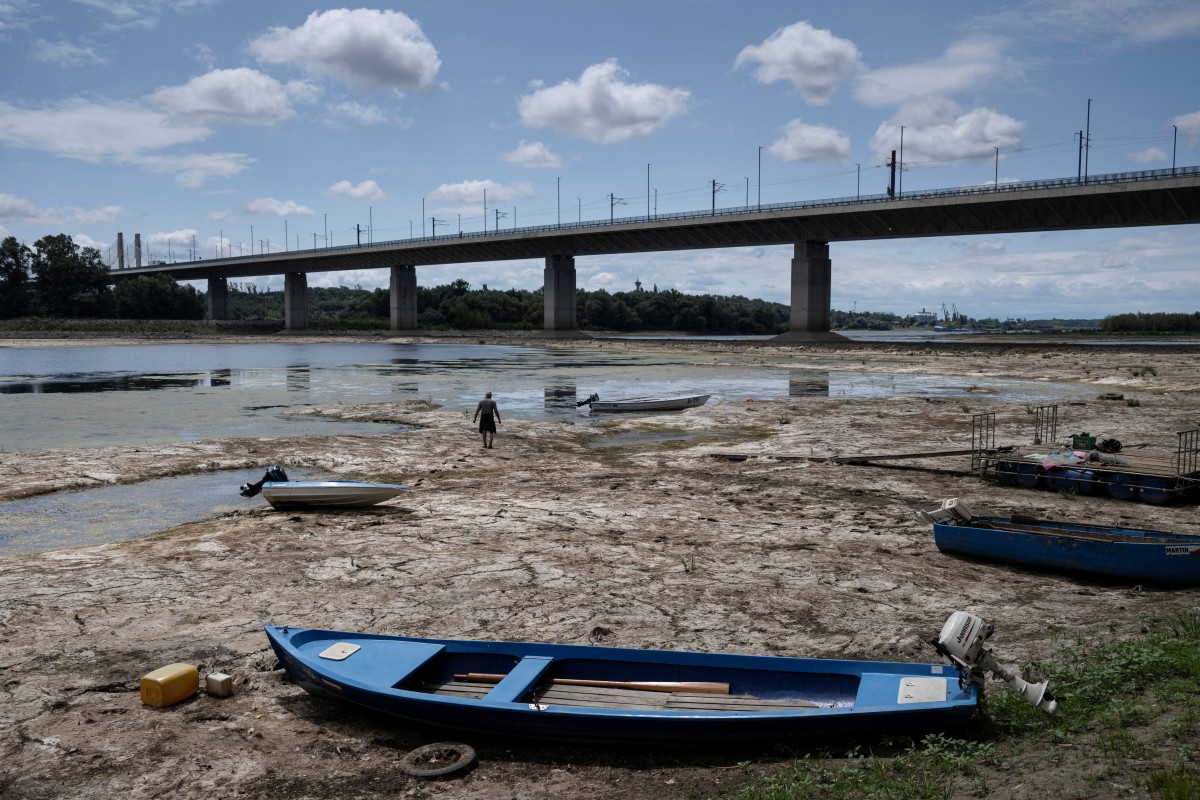
Meanwhile on the Rhine river, which is Germany's most important shipping route, water levels are also at record low levels.
The low level of the Rhine could have economic consequences for several of Germany's industries, such as the chemicals and steel, which depend on the river to transport large quantities of goods.
Many German municipalities have also reported limited and shrinking ground water supplies. The city of Munich issued an emergency decree to limit drinking water use last month.
Number of German breweries shrinks as beer sales fall
The number of breweries in Germany has continued to decline, reflecting a broader drop in beer consumption.
According to figures released by the Federal Statistics Office, there were 1,415 breweries operating in 2025, down from a peak of 1,552 in 2019. This represents a fall of almost nine percent over five years.
Statisticians attribute the trend largely to shrinking beer sales. Breweries and beer warehouses sold around 7.8 billion litres of beer in 2025, a decrease of six percent compared with the previous year and nearly 16 percent lower than in 2019.
The majority of Germany’s breweries remain small producers, with annual output of no more than 100,000 litres. Alongside these businesses, eight major brewing groups each produced at least 200 million litres in 2025.
Bavaria remains Germany’s brewing heartland, accounting for 588 breweries last year, ahead of Baden-Württemberg with 190 and North Rhine-Westphalia with 131. But Bavaria also recorded the largest decline in brewery numbers, falling from 648 in 2019 to 588 in 2025.
Bayer profit up as it shrugs off liability for glyphosate-linked cancer cases
German agrichemical giant Bayer on Tuesday returned to profit in the second quarter, helped by a strong performance at its agricultural business as well as a smaller legal bill.
Special charges "primarily attributable" to litigation costs also declined in the quarter to 172 million euros, down from 981 million euros, Bayer said.
The aspirin maker has spent more than $10 billion settling thousands of cases linked to glyphosate-based herbicides since it acquired the US agrichemical group Monsanto in 2018, developer of the popular Roundup weedkiller.
The International Agency for Research on Cancer considers glyphosate a probable human carcinogen.
The company in June successfully argued before the US Supreme Court that it should be shielded from so-called failure-to-warn legal claims in US states since the US Environmental Protection Agency ruled that Roundup could be sold without any warning label.
Bayer is hoping to bring the saga to a close with a $7.25-billion class action settlement and has said that a favourable US Supreme Court ruling would disincentivise potential opt-outs.
"Our containment strategy is in a strong place, with some important milestones ahead," Bayer CEO Bill Anderson said Tuesday.
Sales of glyphosate-based herbicides meanwhile rose 12.6 percent in the quarter, Bayer said, driven by particularly strong growth in Europe, the Middle East and Africa.
With reporting by DPA and AFP.