Give parliament a vote on quantitative easing

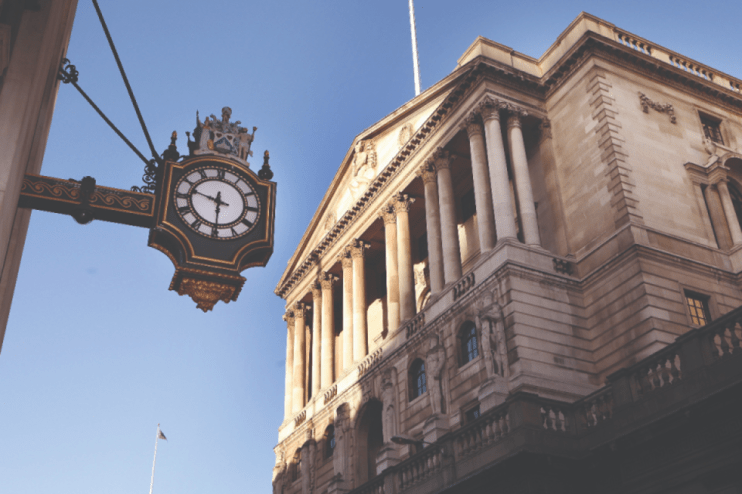
QE should not be the preserve of bean-counting central bankers – money printing is not an abstract issue, it has real consequences for people’s ordinary lives, says Sam Bidwell
If one thing characterises British politics in the post-Thatcher era, it is a serial addiction to avoiding questions about the structure of our economy.
On the NHS, the state pension and social care, politicians of all parties have preferred half measures and quick fixes to long-term solutions, keeping flawed systems ticking along in a perpetual state of ‘just-about-managing’.
Of course, in practice, endless obfuscation makes these structural issues worse.
The mother of all obfuscations is our political approach, or lack thereof, to monetary policy, inflation and debt. On these issues, the collective approach of our political class has been to cover their ears, close their eyes, and hope that the whole nasty business goes away.
But now, like a much-loved band from the 1980s embarking on a comeback tour, monetary policy will return to Parliament’s green benches this week. Reform UK’s Rupert Lowe has tabled a Ten Minute Rule Bill which aims to prohibit the practice of Quantitative Easing (QE), except by the express consent of parliament.
For those unfamiliar, QE is the process by which the Bank of England creates more money, by purchasing financial instruments, such as bonds. Since March 2009, the Bank of England has generated £875bn using QE.
Creating money out of thin air
QE allows the government to run large budget deficits in order to finance additional spending; it is a form of money printing. The Bank of England last used QE in November 2020, as a means of funding the government’s lockdown policies, including furlough and other expensive measures used to prop up the economy. £150bn was created out of thin air.
But even as inflation – ‘the cost of living’ – became the issue de jure in 2022, few commentators made the link between rising costs and the Bank’s QE policies. Price increases were blamed exclusively on rising energy prices, spurred by the removal of Russian gas from international markets in February 2022. The rising cost of energy was undoubtedly a factor in driving inflation – but to ignore the impact of QE is to ignore the elephant in the room.
We should not think of QE as the preserve of bean-counting central bankers – it is not an abstract issue, and has real consequences for ordinary people. The simple reality is that our habitual reliance on quantitative easing has made life more expensive for households across the country; it was a key contributor to the recent spike in inflation. What’s more, QE benefits those who already own financial instruments, such as shares and bonds, by driving up the value of those instruments – while making it more expensive for those without assets to invest.
QE is one of the primary contributors to our growing stock of national debt
And like it or not, we still need to think about debt – and with the costs of QE covered by the government, this is one of the primary contributors to our growing stock of national debt.
We should be extremely careful about using QE, even as a crisis backstop. When we do choose to use it, our democratically elected politicians should be the ones to make that call – they are accountable to us, and can be removed if we disagree with their decision. It would, if nothing else, force politicians to think more carefully about whether we should embark on ambitious spending programmes at times of hardship.
As the past few years have shown, the global economy is far from stable. We may be an island, but we are not immune to international developments. The temptation to use QE will rear its head again soon – and when it does, we must be able to have a real conversation about whether we want to make the requisite trade-offs.
Sam Bidwell is the director of the Next Generation Centre at the Adam Smith Institute