Scotland could keep the pound – but at the cost of any monetary independence

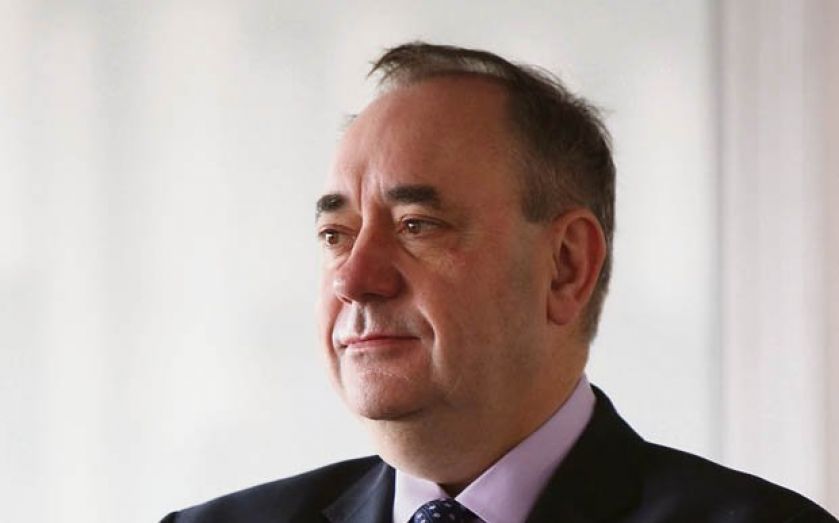
THE CONTROVERSY over the monetary and currency arrangements of an independent Scotland has dominated the referendum campaign, after Alex Salmond’s initial desire for a formal currency union with the rest of the UK was ruled out by all the other major political parties. Salmond has since strongly indicated that Scotland could use sterling unilaterally – a policy known as sterlingisation. However, for all the heat the discussion has thrown up, there has been little light. The debate typically overlooks some critical points.
The first is that Salmond is quite right that there is nothing that a London government should or can do to stop an independent Scotland from using the pound sterling as its currency: the Scots do not have to ask permission to use the pound.
There are many examples of countries that have successfully used other nations’ currencies without formal agreement. Panama, for instance, has used the US dollar as its currency for well over a century. Closer to home, the Irish Free State used the pound sterling for a few years after independence in 1922, and the new Irish pound introduced in 1928 was pegged 1:1 with sterling for over 50 years.
However, there are also potential downsides to a Scottish government that wished to keep the pound as the Scottish currency, or even introduce a new Scottish pound pegged to sterling.
One is that it would have no control over monetary policy – and hence interest rates, money supply and inflation – throughout the British Isles. These would be determined by the policies of the Bank of England. If the Scottish government kept the pound, Scotland would be piggy-backing on English monetary policy, good or bad as that may turn out to be.
There is nothing intrinsically wrong with such an arrangement, but Scotland would then have no say in that monetary policy unless the English government agreed to give it one – for example, in the appointment of Monetary Policy Committee members. That, however, would be a matter for the two governments to agree upon – or not. But failing any such agreement, if the Scottish government disliked the monetary policy of the Bank of England, it would have to put up with it or adopt its own monetary system instead.
What Scotland cannot do is piggy-back on English monetary policy while simultaneously demanding a say over how that monetary policy is determined. In this respect, Scottish independence would mean that an independent England would have every right to set its own monetary policy: it does not need Scotland’s permission.
There is also a bigger problem: the (mostly) taken-for-granted assumption in recent discussions is that Scottish banks would be entitled to support from the Bank of England if they got themselves into difficulties.
In this context, it is worth recalling that Iceland and Ireland were dragged down in 2008 and 2010-2011 respectively by bank asset to GDP ratios of around 900 per cent: their banking systems were so big that, when they collapsed, they effectively bankrupted their own governments.
If Scotland were independent, and if its banks remained in the country, then the ratio of Scottish bank assets to Scottish GDP would be even higher, in the region of 1,000 to 1,200 per cent. This is a very big red flag.
Furthermore, the big Scottish banks are still basket cases, kept afloat only by UK government support. Informed observers worry that there will be further big bank losses and further requests for government assistance – and, at the very least, we can’t be sure there won’t be.
Should the Scottish banks collapse again, they might bring down the Scottish government with it. And the realisation that the Scottish government cannot realistically prop up the Scottish banks presumably helps to explain why the latter are now openly talking about migrating south in the event of independence. That would solve one problem for Salmond, but the mass migration of the financial sector and who knows what else to England would be a less than auspicious start.
If Scotland chooses independence, then the Scottish banks that remain would become Scotland’s problem: Scotland the Brave, indeed. An independent Scotland would have no right to expect that Scottish banks that get into difficulties would be bailed out by the English taxpayer.