Skip to content
Friday 7 August 2026London --:--Frankfurt --:--Zurich --:--
NewslettersSearchEN · DE
MorningWire

European business, markets and politics

FTSE 100
10,901.09
+0.31%
DAX
26,319.45
+0.69%
CAC 40
8,714.93
+0.17%
STOXX 50
6,523.86
+0.33%
  • Europe
  • Markets
  • Business
  • Economy
  • Technology
  • Politics
  • Opinion
More
GermanyFranceBankingAIEnergyFintechPropertyCapital Markets
  • Germany
  • France
  • Europe
  • Markets
  • Business
  • Economy
  • Technology
  • Politics
  • Opinion
  • DE
Monday 15 June 2026 12:16 pm  |  Updated:  Monday 15 June 2026 12:17 pm

Bank of England’s Bailey defends bond sale programme

By: Ali Lyon

Add as a preferred source on Google
Governor Andrew Bailey has launched a defence of the Federal Reserve's independence.
Andrew Bailey has said an interest rate cut if 'off the table'

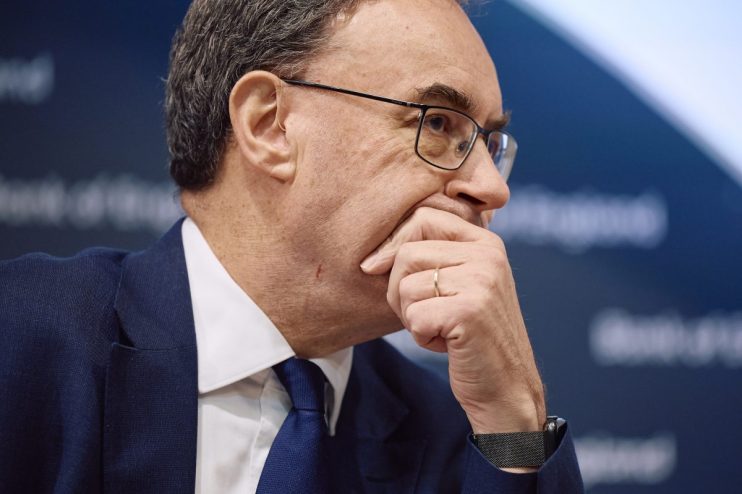
Andrew Bailey has launched a robust defence of the Bank of England’s controversial bond sale programme, arguing it will provide the firepower for another round of quantitative easing in a market downturn.

Writing in The Times, Bailey argued the central bank’s move to hoover up UK government bonds, known as gilts, in the wake of the financial crisis and coronavirus pandemic staved off mass unemployment and propped up the UK’s ailing economy.

He added that its unusual approach to unwinding the buying spree was necessary and neutral for the Exchequer, despite a barrage of criticism from analysts and politicians on the programme’s cost to the Exchequer.

“Quantitative easing did its job,” he wrote. “It protected jobs, boosted spending and supported the economy at the times of crisis. Indeed, many of those who now criticise QE [quantitative easing] were not saying as much at the time.

“Now, we are reducing our gilt holdings to give us the capacity to intervene again in future if needed.”

Since 2022, major central banks have been offloading their vast holdings of government bonds acquired between 2010 and 2021 in a process known as quantitative tightening.

The likes of the European Central Bank and Federal Reserve have adopted a ‘passive’ approach to the programme, letting bonds roll off their balance sheet without replacing them. But the Bank of England has made itself an international outlier by actively selling much of its £875bn gilt portfolio at auctions above and beyond the passive QT being pursued by its counterparts.

In October last year, the Federal Reserve paused even its passive tightening, though new chair Kevin Warsh has previously called on the US central bank to shrink its balance sheet more quickly.

Read more

Bank of England warns Burnham of UK economy’s ‘big issue’

Bank of England Governor Andrew Bailey said the future of interest rates was "more uncertain".

Bailey hits back at QT critics

Critics of the approach, who include Nigel Farage’s Reform UK and a coterie of leading City analysts, have argued that active QT has led to a glut of supply of gilts and put upward pressure on government borrowing costs at a time when they are already at multi-decade highs.

They have also railed against terms agreed by then-Chancellor George Osborne and the central bank in 2010 that leave the taxpayer on the hook for covering £125bn of losses from the programme, piling further pressure on the public finances.

But Bailey said overall its rounds of QE – and now QT – will be cost neutral for the Treasury, which benefited from the revenue and borrowing cost uplift during the Bank’s initial bond buying spree.

“It is sometimes said that the cashflow impact from selling gilts could be avoided if the Bank held bonds to maturity,” he said. “This is incorrect. Sales can alter the timing of the cashflow but they do not add to it.”

The central bank governor was not on the rate-setting Monetary Policy Committee during its first QE programme but oversaw the record bond purchases it made during the pandemic and its decision to adopt active QT in 2022.

The move to auction gilts actively was necessary because unlike other countries, the Treasury’s Debt Management Office issued bonds with much longer time horizons, Bailey wrote in The Times. This means they will not roll off the Bank’s balance sheet as quickly.

“Other countries have issued debt at shorter terms,” he said. “The UK has benefited by issuing longer-term gilts, locking in much lower interest costs for longer. Selling and holding are neutral in terms of their costs, and both have to be set against the benefit of the UK having issued longer-term debt in greater quantities. “

Read more

Rupert Lowe axes pensions triple lock and pledges tax cuts in economic plan

Rupert Lowe, former Southampton FC chairman, smiles while holding files on a city street, wearing a suit and pink tie

Share this article

  • Facebook
  • X
  • LinkedIn
  • WhatsApp
  • Email

Similarly tagged content:

Sections

  • News

Categories

  • Business

People & Organisations

  • Andrew Bailey
  • Bank of Engalnd
  • borrowing costs
  • George Osborne
  • Gilts
  • QE
  • QT
  • quantitative easing
  • quantitative tightening
  • Treasury
  • UK government bonds

Trending Articles

  • Revolut founder’s wealth set to balloon amid talks of share award at $500bn valuation

  • Rupert Lowe axes pensions triple lock and pledges tax cuts in economic plan

  • WPP slashes jobs as revenue continues to fall

  • Liverpool owners tipped to sell – but not to Amazon boss Bezos – by former CEO

  • As it happened: Stocks rise as oil fluctuates after Red Sea attack; US-Iran deal ‘being circulated’

More from Morning Wire

  • Bank of England warns Burnham of UK economy’s ‘big issue’

    Economics
    Bank of England Governor Andrew Bailey said the future of interest rates was "more uncertain".
  • Rupert Lowe axes pensions triple lock and pledges tax cuts in economic plan

    Politics
    Rupert Lowe, former Southampton FC chairman, smiles while holding files on a city street, wearing a suit and pink tie
  • Interest rate cut is ‘off the table’, says Bank of England governor

    Economics
    Governor Andrew Bailey has launched a defence of the Federal Reserve's independence.
  • Bank of England governor opens door to ‘simplifying’ financial rulebook

    Regulation
    Bank of England Governor Andrew Bailey said cited several indicators that the labour market was softening.
  • Bank of England to relax capital rules despite warning of economic threats

    Banking
    Bank of England building on Threadneedle Street, London, showcasing its historic architecture and financial significance
  • Will Britain follow Japan’s great growth gamble?

    Opinion
    Japan Prime Minister Sanae Takaichi speaking at a press conference, highlighting her leadership and political agenda
  • Rachel Reeves’ legacy of tinkering with the City is not enough, says Mel Stride

    Economics
    Mel Stride addressing an audience at a business conference, standing at a podium with a presentation screen behind him
  • Bank of England holds interest rates but warns of rises to come

    Economics
    Bank of England headquarters in 2025, showcasing modern architecture and iconic London skyline in the background.
MorningWire

Independent European business, markets and political news for decision-makers.

Morning Briefing

Europe

  • Germany
  • France
  • Europe
  • UK & Ireland

Business

  • Markets
  • Banking
  • Technology
  • Energy
  • Property
  • Fintech

Editorial

  • Opinion
  • Editorial Policy
  • Corrections
  • Contact

Company

  • About Morning Wire
  • Privacy Policy
  • Terms of Use
  • Cookie Policy
© 2026 Morning Wire Ltd · Published by Morning Wire Media, Bahnhofstrasse 65, 8001 Zürich, Switzerland
Privacy · Terms · Cookies · Facebook