Skip to content
Saturday 22 August 2026London --:--Frankfurt --:--Zurich --:--
NewslettersSearchEN · DE · FR
MorningWire

European business, markets and politics

FTSE 100
10,816.56
+0.64%
DAX
26,136.56
+0.59%
CAC 40
8,484.43
+0.37%
STOXX 50
6,462.22
+0.63%
  • Europe
  • Markets
  • Business
  • Economy
  • Regulation
  • Politics
  • Opinion
More
GermanyFranceEU InstitutionsCompetitionPublic AffairsBankingTechnologyEnergy
  • Germany
  • France
  • Europe
  • Markets
  • Business
  • Economy
  • Regulation
  • Politics
  • Opinion
  • DE
Tuesday 11 June 2024 7:05 am  |  Updated:  Tuesday 11 June 2024 11:00 am

Wage growth barely moves but unemployment creeps up as Bank of England considers rate cuts

By: Chris Dorrell

Add as a preferred source on Google
Investors are predicting more interest rate cuts this year than they previously had.

Wage growth remained stubbornly high over the past quarter, but unemployment crept up, giving the Bank of England differing signals on how its interest rate hikes are impacting the economy.

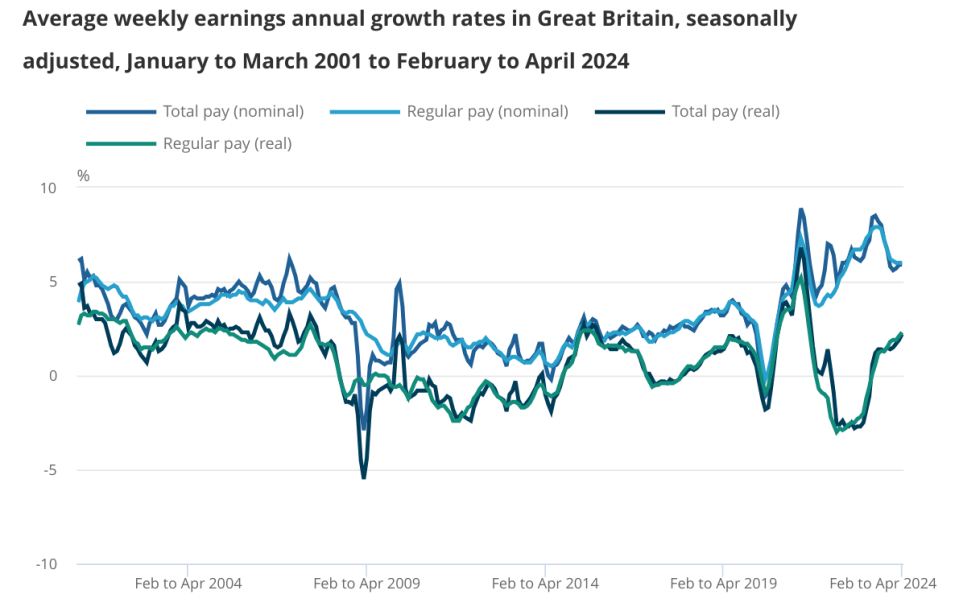
Annual pay growth excluding bonuses averaged 6.0 per cent between February and April, according to figures from the Office for National Statistics (ONS), unchanged on last month and marginally below expectations.

Including bonuses, however, annual wages rose 5.9 per cent. This was unchanged from last month, after an upward revision to those figures, but higher than economists expected.

The continued stickiness in wage growth was likely influenced by the near 10 per cent increase in the National Minimum Wage in April, although markets will be relieved there was no big increase.

Taking into account inflation, real pay growth was 2.3 per cent, its highest level since August 2021.
Source: ONS

Unemployment meanwhile rose to 4.4 per cent between February and April, up from 4.3 per cent previously. Economists had expected it to remain flat, although there are some question marks about the accuracy of the data.

The data also showed that the number of vacancies continued decreasing for the 23rd consecutive quarter.

The figures will be closely scrutinised as policymakers at the Bank of England consider when to cut interest rates. Wage growth has remained stubbornly strong throughout the year, prompting concern that it could contribute to sticky prices.

Yael Selfin, Chief Economist at KPMG UK said: “Today’s data are unlikely to warrant an immediate shift in policy from the Bank of England”.

Read more

Public sector makes wage growth higher than expected

London has defied national trends as job postings in the capital rose.

Rate-setters have repeatedly said they need to see further progress on services inflation before cutting rates. Inflation in the labour-intensive services sector is heavily influenced by wage growth.

Forward looking surveys suggest there will be more progress on wage growth in the months ahead. Firms surveyed by the Bank of England in May expect wages to grow 4.1 per cent over the next year, the lowest level since the Bank first ask the question back in May 2022.

“We expect wage pressures to ease gradually in the coming months as the labour market cools, with unemployment rising relative to vacancies.” Monica Michail, an associate economist at the National Institute for Economic and Social Research (NIESR) said.

Hot inflation data for April has taken a June rate cut off the table, but economists still think August is on the cards if price pressures continue to moderate.

“We expect the MPC to stay put at its June meeting and reassess the incoming data flow over the summer before it embarks on cutting interest rates,” KPMG’s Selfin said.

The European Central Bank (ECB) cut interest rates for the first time in five years last week, but most investors interpreted the decision as a ‘hawkish’ cut and expect the ECB to wait before cutting rates again.

The Fed meanwhile announces its latest rate decision tomorrow with investors certain rates will be left on hold.

Elsewhere, economic inactivity rose again in the latest quarter to 22.3 per cent, largely driven by those aged between 50-64. Increasing levels of inactivity, driven by long-term sickness, has been a major problem for the UK economy over the past couple of years.

Read more

How patient can the Bank of England be?

Historic Royal Exchange building in London with modern skyscrapers behind, clear blue sky.

Share this article

  • Facebook
  • X
  • LinkedIn
  • WhatsApp
  • Email

Similarly tagged content:

Sections

  • News
  • Markets & Economics

Categories

  • Economics

People & Organisations

  • Bank of England
  • UK Interest Rates
  • unemployment
  • Wage growth

Related Topics

  • Bank of England
  • employment and wages
  • UK inflation
  • UK interest rates
  • UK jobs, employment and wages

Trending Articles

  • House prices in wealthy London boroughs fall by up to £300,000

  • Ratcliffe’s Ineos saves Runcorn plant

  • Amazon says it buys books in bulk to ‘improve products’

  • Mike Ashley’s Frasers offers to pay personal shoppers in Harvey Nichols takeover

  • As it happened: FTSE 100 rallies after JD Sports drags on blue chips; oil jumps again

More from Morning Wire

  • Public sector makes wage growth higher than expected

    Economics
    London has defied national trends as job postings in the capital rose.
  • How patient can the Bank of England be?

    AD
    Historic Royal Exchange building in London with modern skyscrapers behind, clear blue sky.
  • Goldman: Junior white-collar workers squeezed hardest by AI hiring slump

    AI
    People waiting outside a job centre, highlighting unemployment issues and job search challenges in the current economy.
  • 22 months of cuts: Jobs crisis deepens despite growth boost 

    Economics
    London has defied national trends as job postings in the capital rose.
  • Inflation leaps to 2.9 per cent in blow to Burnham 

    Economics
    Burnham cityscape showcasing modern architecture, bustling streets, and vibrant community life in a thriving urban setting
  • Jobless Banquet: Youth unemployment surge ‘sends Neets to KFC’

    Retail
    Redhead woman excitedly biting into a piece of KFC fried chicken dipped in green sauce.
  • War and tax: How the UK economy could get knocked off course

    Economics
    Andy Burnham speaking at a public event, emphasizing local governance and policy changes, wearing a suit and gesturing pas...
  • UK economy’s rebound fails to stem two years of mass job losses 

    Economics
    LONDON, UNITED KINGDOM - JANUARY 31: The Shard is seen on the horizon as commuters cross London Bridge during the morning rush hour on January 31, 2023 in London, United Kingdom. The IMF reports that the UK economy will contract by 0.6% in 2023, as opposed to the previous prediction it might grow, and will perform worse than many other advanced economies, including Russia.The cost of living continues to hit households with grocery inflation for the first four weeks of 2023 rising to 16.7% which would add a further £788 per year to family food bills. (Photo by Leon Neal/Getty Images)
MorningWire

Independent European business, markets and political news for decision-makers.

Morning Briefing

Europe

  • Germany
  • France
  • EU Institutions
  • Europe

Business

  • Markets
  • Business
  • Economy
  • Regulation
  • Competition
  • Public Affairs

Editorial

  • Opinion
  • Editorial Policy
  • Corrections
  • Contact

Company

  • About Morning Wire
  • Privacy Policy
  • Terms of Use
  • Cookie Policy
© 2026 Morning Wire Ltd · Published by Morning Wire Media, Bahnhofstrasse 65, 8001 Zürich, Switzerland
Privacy · Terms · Cookies · Facebook